
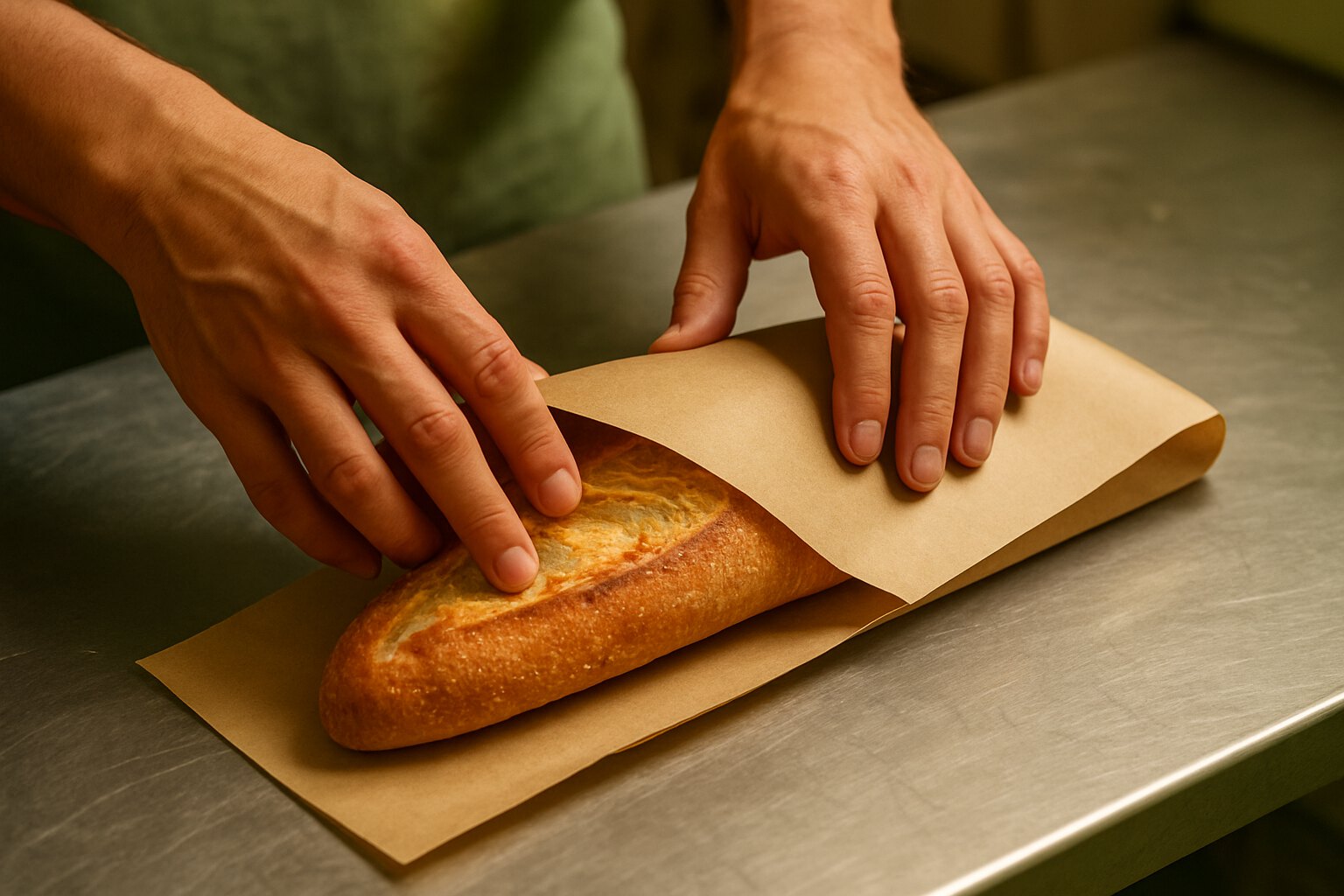
Why we wrap in paper and not in a plastic bag
Customers often ask this with a compliment attached: “nice that you wrap in paper, good for the environment”. The compliment is fair but the order is backwards.
The first reason is technical. A plastic bag ruins the very loaf it is holding. The environmental part comes along with it, but it is not the origin.
What a plastic bag does to a loaf
A freshly wrapped loaf is still warm and still giving off vapour. That is normal and unavoidable — warm bread produces steam.
Sealed in plastic, that vapour has nowhere to go. It condenses into droplets on the inside of the bag and runs back into the loaf. After fifteen or twenty minutes the crust has taken up the water and lost its crispness.
Paper does the opposite: it lets the vapour through. The loaf still cools, steam still rises, but it escapes rather than returning. The crust stays dry, and it keeps its sound.
This is why wrapping in paper is not a moral choice but a technical one. Wrap in plastic and fifteen minutes later the customer receives a different loaf from the one that was wrapped.
But paper has limits too
To be fair, paper is not the answer to every situation:
- It fails against water. In rain, paper alone lets the water through. That calls for an outer waterproof layer — two different jobs needing two different layers: paper to let vapour out, an outer layer to keep rain off.
- Wet items need a tub. Pickles packed separately cannot be wrapped in paper.
- A loaf heavy with sauce soaks through the paper and tears it. Another reason not to ask for extra sauce.
The environmental part
It is real, but worth stating at the right size rather than inflated:
- Paper breaks down in the environment far faster than plastic, and does not fragment into microplastics.
- A thin sheet of wrapping paper uses far less material than a box or a thick bag.
- But paper is not free — it still takes timber, water and energy to produce.
So the best option remains the simplest: do not take an extra bag if you do not need one. A loaf already wrapped in paper can be carried in your hand.
Asking for it differently
Three common requests, all straightforward, just say so when ordering:
- “No bag, thanks” — for one or two loaves carried by hand. The most common request and the tidiest.
- “Into my own bag” — hand over your tote and the staff will pack into it.
- “Salad separately” — salad and pickles in their own tub, the loaf wrapped in paper. Worth asking if you will eat a few hours later.
For deliveries a box is unavoidable, since the loaf has to survive the journey. But inside the box each loaf is still wrapped in paper, and the salad can still be packed separately.
Wrapping at home
Bought several, did not finish them, want to keep one for tomorrow — how you wrap decides what you get in the morning:
- Take out the salad and pickles first. Still the most important step, whatever you wrap in.
- Let it cool completely before wrapping. Wrapping it warm traps the steam, paper included.
- Not old newspaper — printing ink is not something to put against food. Baking paper, food wrap paper or a paper bag is fine.
- Wrap loosely, not tightly. Bound tight, the paper sits against the crust with no room for vapour to escape.
For several days, the freezer is the right place — wrapped well and frozen, starch recrystallisation stops altogether. Thaw at room temperature and reheat in a dry pan, and the loaf is close to new.
One small thing worth mentioning
Paper does one more job people rarely notice: it keeps oil off your hands, and peels back bite by bite. Plastic is slippery, the loaf tends to slide, and it takes two hands.
This is why Vietnamese banh mi was wrapped in paper long before anybody talked about the environment — it is simply the wrapping that suits the food.
At the shops
The five shops are open 24 hours: 38 Lê Thị Riêng, 15B Nguyễn Thị Minh Khai, 2B Trần Hưng Đạo and 148B Đề Thám in District 1, and 210 Bùi Văn Ba in District 7. Bringing a tote? Hand it over when you pay. For delivery call 0923.183.183; orders from 500,000d within 5km are delivered free.
Quick questions
Why not use a plastic bag to be safe?
Because plastic traps the steam. Vapour from a warm loaf condenses on the inside of the bag and runs back in, and after fifteen or twenty minutes the crust has lost its crispness. Paper lets it escape.
So is paper about the environment or about quality?
Quality first. The environmental part comes with it but is not the origin — Vietnamese banh mi was wrapped in paper long before anybody discussed it.
Does paper hold up in the rain?
Not alone, so an outer waterproof layer is added. Two different jobs needing two different layers: paper for vapour, the outer layer for rain.
Can I bring my own bag?
Yes — hand it over when you pay. For one or two loaves you do not really need a bag at all, since they are already wrapped.
Are delivery orders wrapped in paper too?
Yes. The outer box is there to survive the journey, but each loaf inside is still wrapped in paper, and the salad can be packed separately on request.
Is paper genuinely better for the environment?
Better than plastic in that it breaks down faster and does not become microplastic, but paper still takes timber, water and energy. The best option is still not taking an extra bag you do not need.

Why the menu keeps Vietnamese names instead of translating them
Translating every item into English sounds friendlier. But with vegan food, translation misleads in exactly the place where it matters most.
The De Tham backpacker quarter shop: what foreign customers ask most
The shop sits in the backpacker quarter, so questions from foreign customers fall into a few clear groups — several of which local customers never ask
From Ben Thanh Market to each shop: which one is closest
The four District 1 shops sit around the centre but in four different directions. From Ben Thanh, which is nearest depends on whether you're walking o
Searching 'vegan banh mi near me': how to get the right results
The obvious search returns a muddle: places closed years ago, meat restaurants with a vegan section, and places kilometres away.
 ›
×

Vegan banh mi and plant-based coffee in Ho Chi Minh City. Five shops open 24/7 including Sundays and holidays. Free delivery within 5km on orders from 500,000d.
Brand strategy by Ten Mien Dang Cap
© 2026 Bánh Mì XANH. All rights reserved.