
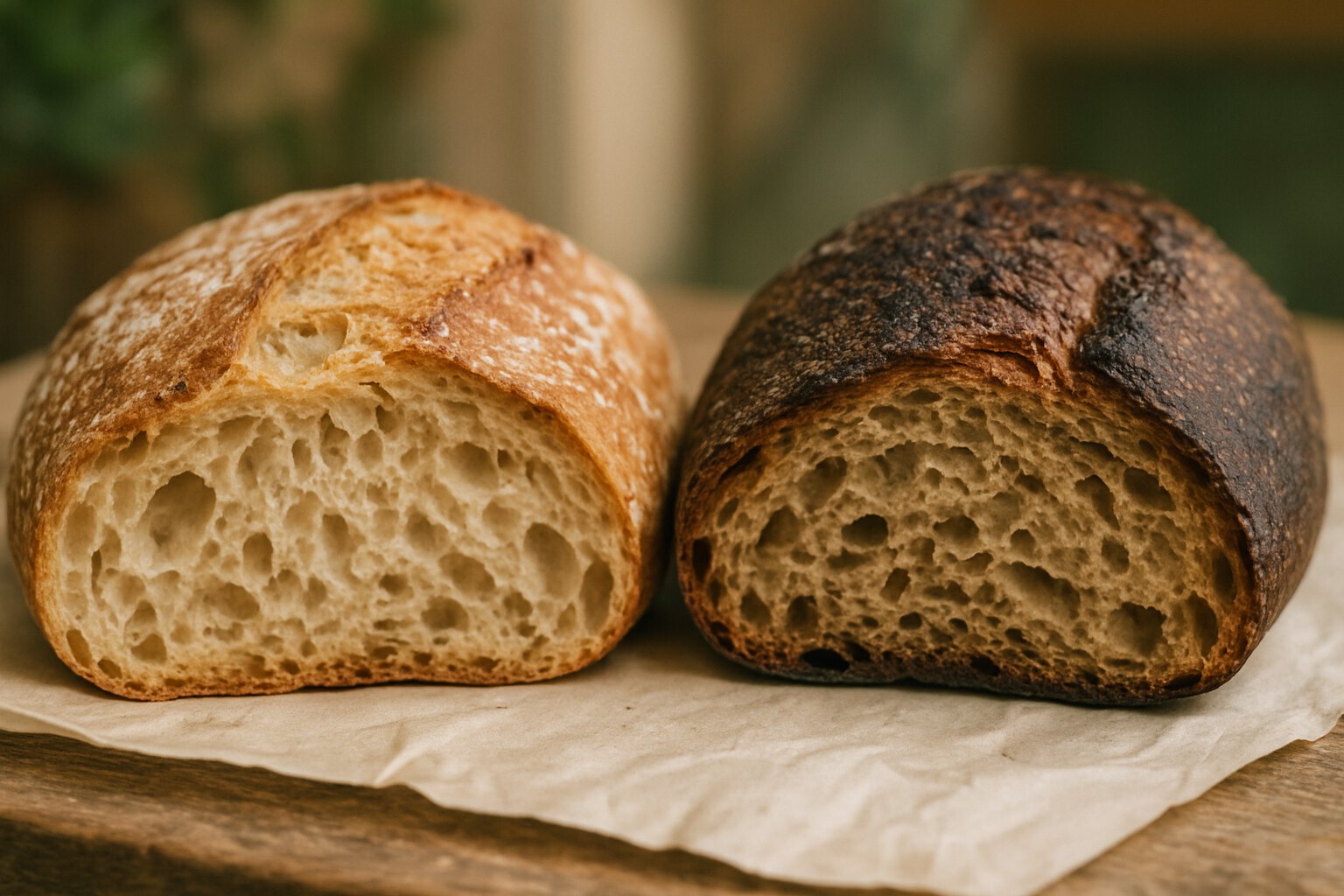
Why Vietnamese bread has a thin crackly crust and a baguette does not
Put a Vietnamese loaf next to a French baguette and the difference is immediate: the Vietnamese one is lighter, thinner-crusted, with a more open crumb; the French one is heavier, with a thick chewy crust and a dense crumb.
They share an origin — bread arrived in Vietnam with the French — but a century later they are two different things. The difference is not skill. It is three specific things.
1. Flour: how much protein
The root difference. Wheat flour comes in grades distinguished chiefly by protein content — that is, potential gluten.
- High-protein flour builds a strong, chewy gluten network. A strong network holds gas for longer, giving a dense chewy crumb and a thick crust.
- Lower-protein flour builds a weaker, more fragile network. A more open crumb, a thin crust that shatters.
Vietnamese bread sits towards the second. Many recipes go further and add rice flour or starch — which contain no gluten at all — to weaken the network deliberately. The result is a very light loaf whose crust shatters into small flakes under the bite.
It is also why the crumb is so much more open: a weak gluten network cannot hold a fine even structure, so the gas gathers into large holes.
2. Water: how much is in the dough
More water in a dough means a moister, chewier crumb and a thicker crust. A traditional baguette uses a high hydration and a long fermentation for flavour.
Vietnamese bread generally uses less water and a quicker rise. A drier, lighter crumb — and one that suits being filled with wet ingredients. This is the crux, because a Vietnamese loaf exists to be a sandwich rather than to be eaten with butter and cheese.
A chewy French crumb packed with pickles and sauce goes claggy. An open Vietnamese crumb absorbs some of the liquid and still holds its shape.
3. Baking: hotter and faster
Vietnamese bread is generally baked hotter for a shorter time. Fast heat means the crust forms before the crumb has set, so the crust stays thin and the crumb springs open.
A baguette bakes longer at a slightly lower temperature, and the crust has time to thicken and darken.
Steam in the oven plays a part too: it delays crust formation, letting the loaf expand further before the crust hardens — a technique used in both traditions, in different measure.
Climate plays a part too
A factor few people consider: air humidity.
A thin crisp crust keeps well in a dry climate. In Saigon the humidity is high and a crust takes up moisture quickly — so a Vietnamese loaf is designed to be eaten immediately, not kept for the day. Bought in the morning, eaten in the morning.
Which is why Vietnamese bread is baked in small batches through the day, while in France buying once or twice a day suffices.
So which is better?
The wrong question. They were made for two different jobs:
- A baguette is a base for butter, cheese and pâté — accompaniments with little moisture. A chewy crumb holds its structure when sliced.
- Vietnamese bread is a casing for a complete meal — pickles, salad, sauce, filling. An open crumb and a thin crust are a technical requirement rather than a lesser version.
Put differently: the Vietnamese loaf is an engineering solution to a different problem, and it solves it neatly.
What that means for a vegan loaf
Vegan fillings — fried tofu, vegan cold cut, pickles, salad — carry more moisture than some traditional meat fillings. So the absorbent open crumb of Vietnamese bread matters all the more.
It is also why packing the salad separately for a journey has such a visible effect: the crumb has already absorbed its own moisture, and adding the salad's is beyond it.
Banh Mi XANH bakes in batches, never leaving bread more than four hours on the shelf. The five shops are open 24 hours: 38 Lê Thị Riêng, 15B Nguyễn Thị Minh Khai, 2B Trần Hưng Đạo and 148B Đề Thám in District 1, and 210 Bùi Văn Ba in District 7. Call 0923.183.183; orders from 500,000d within 5km are delivered free.
Quick questions
Why is the Vietnamese crumb so much more open?
Because the gluten network is weaker — lower-protein flour, and many recipes add rice flour, which has no gluten. A weak network cannot hold a fine even structure, so gas gathers into large holes.
Is adding rice flour a way of cutting cost?
No, it is a deliberate technical choice. Rice flour weakens the gluten network, producing a light loaf with a crust that shatters — exactly what a sandwich full of wet filling needs.
Why does a chewy French crumb not suit a sandwich?
Because packed with pickles and sauce it goes claggy. An open Vietnamese crumb absorbs some of the liquid and still holds its shape.
How does hot fast baking differ?
Fast heat forms the crust before the crumb sets, so the crust stays thin and the crumb springs open. Longer baking at a lower temperature lets the crust thicken and darken.
Why must Vietnamese bread be eaten immediately?
Because the humidity here is high and a thin crust takes up moisture quickly. The loaf is designed to be eaten fresh — which is also why it is baked in small batches through the day.
Which one is better?
They were made for two different jobs. A baguette is a base for butter and cheese, with a chewy crumb that slices. A Vietnamese loaf is a casing for a whole meal — the open crumb and thin crust are a requirement, not a shortcoming.

Vegan mock meat: where it came from and why it's argued about
Vegan dishes shaped and named after meat dishes go back further than most people think. So does the argument surrounding them.
'Vegan' on the packaging: how to read the label properly
The word on the front doesn't always say enough. The only reliable method is reading the ingredient list — and knowing which names get overlooked.
Where vegan travellers get stuck in Vietnam
Vietnam has a long vegetarian tradition, yet fully plant-based visitors still get stuck — usually in places nobody expects.
The seventh lunar month: how vegan demand rises and how shops cope
The whole seventh lunar month is peak season for vegetarian food, not just the full moon. It's the month when the rhythm of trade changes most.
 ›
×

Vegan banh mi and plant-based coffee in Ho Chi Minh City. Five shops open 24/7 including Sundays and holidays. Free delivery within 5km on orders from 500,000d.
Brand strategy by Ten Mien Dang Cap
© 2026 Bánh Mì XANH. All rights reserved.