
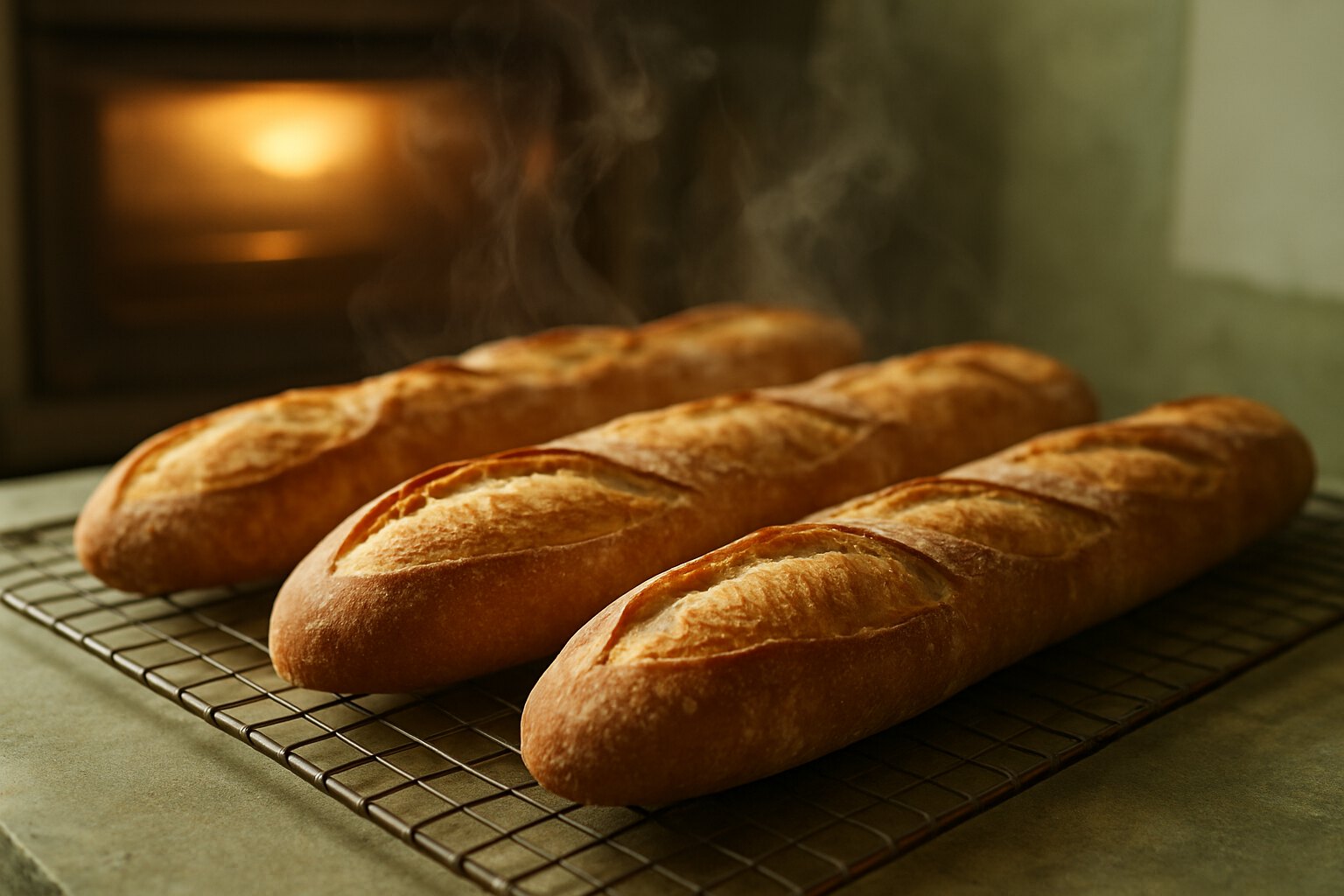
Baked in batches, never more than four hours on the shelf: why
A loaf that has been on the shelf four hours and one that has been there eight look almost identical. Same colour, same shape, same firmness to the touch. The difference only shows when you bite it.
Four hours is not a round number chosen for neatness. It is how long a loaf keeps what makes it a loaf.
Two things happen at once after baking
The crumb: starch recrystallises
During baking, the starch in the flour absorbs water and swells, losing its crystalline structure — that is when the crumb becomes open and soft.
The moment it leaves the oven the reverse begins. The starch chains re-order into crystals and push water out. The crumb steadily loses its softness and turns dry and crumbly.
This is the same mechanism that makes cold rice go grainy and tapioca pearls go hard. One process, three different foods.
The crust: it absorbs moisture
A crust is crisp because it is drier than the crumb. But the water in the crumb does not stay put — it moves outward, and the crust takes it up.
So the crumb dries out while the crust dampens. Opposite directions, both making the loaf worse.
Why four hours
In ordinary conditions the timeline runs roughly:
- 0 to 1 hour — the peak. Crust clearly crisp, crumb still warm and soft.
- 1 to 4 hours — still good. The crust loses crispness gradually but still makes a sound; the crumb is still soft.
- 4 to 8 hours — noticeable. Crust leathery, crumb going crumbly.
- After 8 hours — still edible, but it has become a different thing.
Four hours is the point at which the person eating starts to notice, not the point at which bread spoils. That distinction matters: this is a question of quality, not of food safety.
In Saigon there is an additional factor: high air humidity, so a crust takes up moisture faster than in a dry climate. On a wet day the window is shorter still.
What batch baking costs
Baking once for the whole day is far easier: one oven cycle, one set-up, no need to estimate.
Batch baking is the opposite:
- You have to estimate the trade hour by hour. Estimate low and you run out mid-session; estimate high and you throw bread away.
- The oven runs several times a day, costing more power and more labour.
- Customers sometimes wait a few minutes for a batch.
In exchange for one thing: the loaf reaching the customer is inside that four-hour window.
Not only the crust
The same principle applies to the fillings:
- Fried tofu — clearly crisp for the first 10 minutes, still crisp to about 20. So it too is fried in small batches.
- Tofu and vegan cold cut — made fresh daily, never held overnight.
- Vegetables — delivered early in the morning, washed and cut just before service.
- Pickles — at their best one to four hours after steeping.
Four components with four different windows, and the kitchen's job is to line them up so they coincide at the moment a loaf is wrapped.
What it means for you
- Eat within an hour of buying, ideally.
- Buy in the busy hours, when batches come out continuously and the bread is fresher than in a quiet stretch.
- Keeping it overnight? Wrap in paper and leave it out, not in the fridge — that is the temperature range where starch recrystallises fastest.
- Soft crust? A dry pan for two or three minutes brings it back.
At the shops
The five shops are open 24 hours, so there is a batch from that day at any hour: 38 Lê Thị Riêng, 15B Nguyễn Thị Minh Khai, 2B Trần Hưng Đạo and 148B Đề Thám in District 1, and 210 Bùi Văn Ba in District 7. Call 0923.183.183; orders from 500,000d within 5km are delivered free.
Quick questions
Why four hours and not some other number?
Because that is when the person eating starts to notice. Before it the crust loses crispness gradually but still sounds right; after it the crust is leathery and the crumb crumbly. A quality question, not a safety one.
Does bread go stale by drying or by dampening?
Both, in opposite directions. The crumb dries as starch recrystallises and pushes water out; the crust dampens by taking that same water up.
How does batch baking differ from baking once?
Batch baking means estimating the trade hour by hour, running the oven several times, and customers occasionally waiting a few minutes. In exchange, the loaf reaching you is inside that four-hour window.
When is the bread freshest?
In the busy hours, when batches come out continuously. In a quiet stretch one batch serves for longer.
How should I keep it overnight?
Wrapped in paper and left out, not in the fridge — that is the range where starch recrystallises fastest. In the morning, a dry pan for two or three minutes restores the crust.
Do the fillings have their own windows?
Yes, and different ones. Fried tofu is clearly crisp for ten minutes; tofu and cold cut are made fresh daily; pickles are best one to four hours after steeping. The kitchen's job is to make those windows coincide when the loaf is wrapped.

Why the menu keeps Vietnamese names instead of translating them
Translating every item into English sounds friendlier. But with vegan food, translation misleads in exactly the place where it matters most.

The De Tham backpacker quarter shop: what foreign customers ask most
The shop sits in the backpacker quarter, so questions from foreign customers fall into a few clear groups — several of which local customers never ask

From Ben Thanh Market to each shop: which one is closest
The four District 1 shops sit around the centre but in four different directions. From Ben Thanh, which is nearest depends on whether you're walking o

Searching 'vegan banh mi near me': how to get the right results
The obvious search returns a muddle: places closed years ago, meat restaurants with a vegan section, and places kilometres away.
 ›
×

Vegan banh mi and plant-based coffee in Ho Chi Minh City. Five shops open 24/7 including Sundays and holidays. Free delivery within 5km on orders from 500,000d.
Brand strategy by Ten Mien Dang Cap
© 2026 Bánh Mì XANH. All rights reserved.