
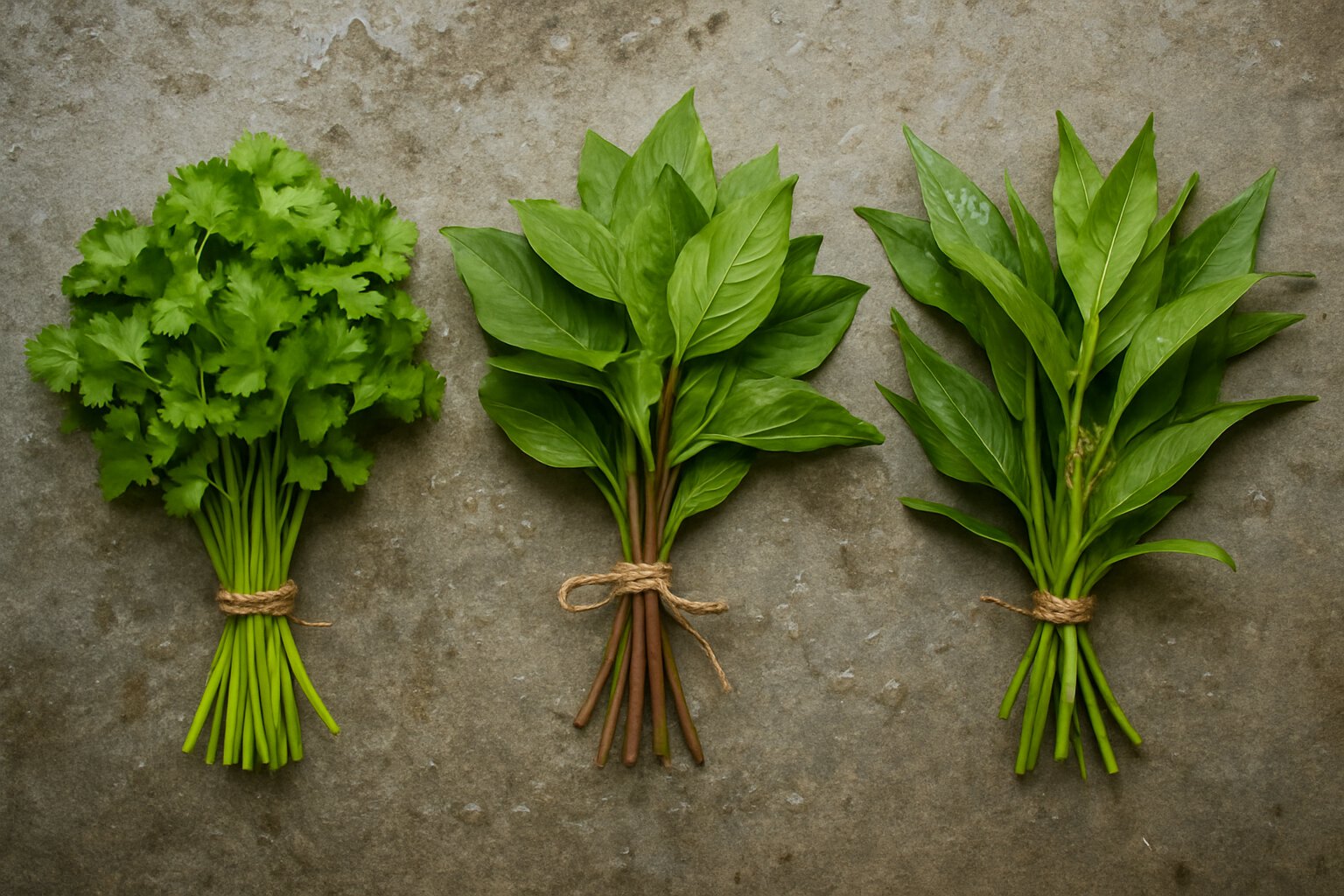
Which herb goes with which filling: coriander, Thai basil and rau răm are not interchangeable
Plenty of people treat the herbs in a banh mi as decoration — in for the green, no great loss if missing. Anyone who makes them knows the opposite: changing the herb changes the dish, even with the filling untouched.
The reason is that the three most familiar herbs do three entirely different jobs.
Three herbs, three jobs
Coriander — it lifts
Coriander is fresh, faintly citrus, with a note that is hard to name and instantly recognisable. Its job is to lift a heavy loaf. Fried filling, rich sauce — a few bites in and it starts to weigh; a sprig of coriander cuts straight through that.
Coriander is very fragile with heat. Put it into a loaf that is still hot and it wilts and turns within minutes. So it always goes in last, once the filling has settled.
Best with: Thập Cẩm and Thượng Hạng Premium — the two fullest loaves, the ones that most need lightening.
Thai basil — it deepens
Thai basil (purple-stemmed, small-leaved, the one served with phở) is warm and sweet, faintly aniseed, with a slight tingle at the back of the tongue. It does not lighten a loaf — it thickens the flavour, adding a layer underneath.
Thai basil takes heat better than coriander. Against hot filling it releases more aroma rather than collapsing, which is why it suits a loaf built on something freshly fried.
Best with: Đậu Hũ Cay — the aniseed of the basil and the chilli of the sauce go together naturally, the way Thai cooking uses them.
Rau răm — it sharpens
Vietnamese coriander is the strongest of the three: peppery, faintly bitter at the finish, and very much itself. It neither lifts nor deepens — it drives a sharp line through the middle of everything else.
Because it is strong, it is also the easiest to overdo. Two or three leaves in a loaf is plenty; a handful drowns everything else and anyone unfamiliar will find the loaf simply strange.
Best with: loaves built on beans, where the base flavour is slightly earthy and wants something cutting across it. If you have not had it before, ask for a little or leave it out — no trouble at all.
Why they cannot be swapped
If the three differed only in intensity they could substitute for one another. But they differ in direction:
- Coriander pulls the flavour upward, towards fresh and light.
- Thai basil pulls it downward, towards warm and sweet.
- Rau răm pulls it sideways, towards peppery and sharp.
Swap coriander for Thai basil in a Thập Cẩm and the loaf is not wrong, but it gains weight exactly where it needed to lose some. Swap Thai basil for coriander in an Đậu Hũ Cay and the chilli loses what it was leaning on, and reads as bare.
Two more you will meet
- Spring onion — not a herb in the above sense, but it adds a mild pungency and a very small crunch. The white part is sharp, the green part gentle.
- Perilla — rare in banh mi but surprisingly good with tofu. Slightly medicinal, slightly minty, almost as strong as rau răm, so use it sparingly too.
Keeping herbs fresh at home
Herbs bought home usually wilt within two days, almost always from being stored wrong:
- Do not wash before storing. Water sitting on the leaves is where rot starts. Wash them when you are about to use them.
- Stand the stems in a glass of water like flowers, drape a loose plastic bag over the top, and put it in the fridge. Coriander keeps a week this way.
- Keep Thai basil out of the fridge — cold turns the leaves black very quickly. It is the one of the three that does not like refrigeration.
Ordering
Herbs are adjusted as you order: more, less, or one particular kind left out. Anyone who does not get on with rau răm should say so up front, since it is the one most likely to surprise the unfamiliar.
The five shops are open 24 hours: 38 Lê Thị Riêng, 15B Nguyễn Thị Minh Khai, 2B Trần Hưng Đạo and 148B Đề Thám in District 1, and 210 Bùi Văn Ba in District 7. For delivery call 0923.183.183; orders from 500,000d within 5km are delivered free.
Carrying a loaf any distance? Ask for the herbs separately. They are the first thing to wilt and the fastest way to soften a crust.
Quick questions
Can coriander and Thai basil be swapped?
Better not. Coriander pulls the flavour towards fresh and light, Thai basil towards warm and sweet — opposite directions. Swapping does not make the loaf wrong, but it removes exactly what it needed.
Is rau răm too strong?
It is the strongest of the three and the easiest to overdo. Two or three leaves per loaf is plenty; more and it drowns everything. If it is unfamiliar, ask for a little or leave it out.
Why do the herbs go in last?
Heat. Coriander meeting hot filling wilts and turns within minutes. Thai basil copes better but should still not be buried under something hot.
Can Thai basil go in the fridge?
Better not — cold blackens the leaves quickly. It is the one of the three to keep out. Coriander, by contrast, keeps a week with its stems in a glass of water in the fridge.
Which herb suits Đậu Hũ Cay best?
Thai basil. Its warm aniseed and the chilli in the sauce go together naturally, and it stands up to filling that has just come out of the fryer.
Can I have no herbs at all?
Yes, just say so when ordering. The loaf will feel slightly heavier without anything cutting the richness, so people who skip the herbs often ask for extra pickles instead.

What to eat alongside a banh mi to make it a complete meal
A sandwich has starch and protein but is short on a few things. Adding one or two items is the difference between a stopgap and a proper meal.

Salt, pepper and sugar in a vegan sandwich: why vegan food tastes flat
Vegan food gets called bland, but not because it's under-salted. The cause is something plant ingredients lack — and adding salt is the wrong fix.
Ordering Spicy Tofu when you can't take heat: four adjustments
The heat in a sandwich doesn't come from one place, so it can be dialled down by degrees rather than being all-or-nothing.
How much is in one banh mi, and how long does it hold you
A simple question with a three-part answer — and the part that matters most isn't the weight of the sandwich.
 ›
×

Vegan banh mi and plant-based coffee in Ho Chi Minh City. Five shops open 24/7 including Sundays and holidays. Free delivery within 5km on orders from 500,000d.
Brand strategy by Ten Mien Dang Cap
© 2026 Bánh Mì XANH. All rights reserved.