
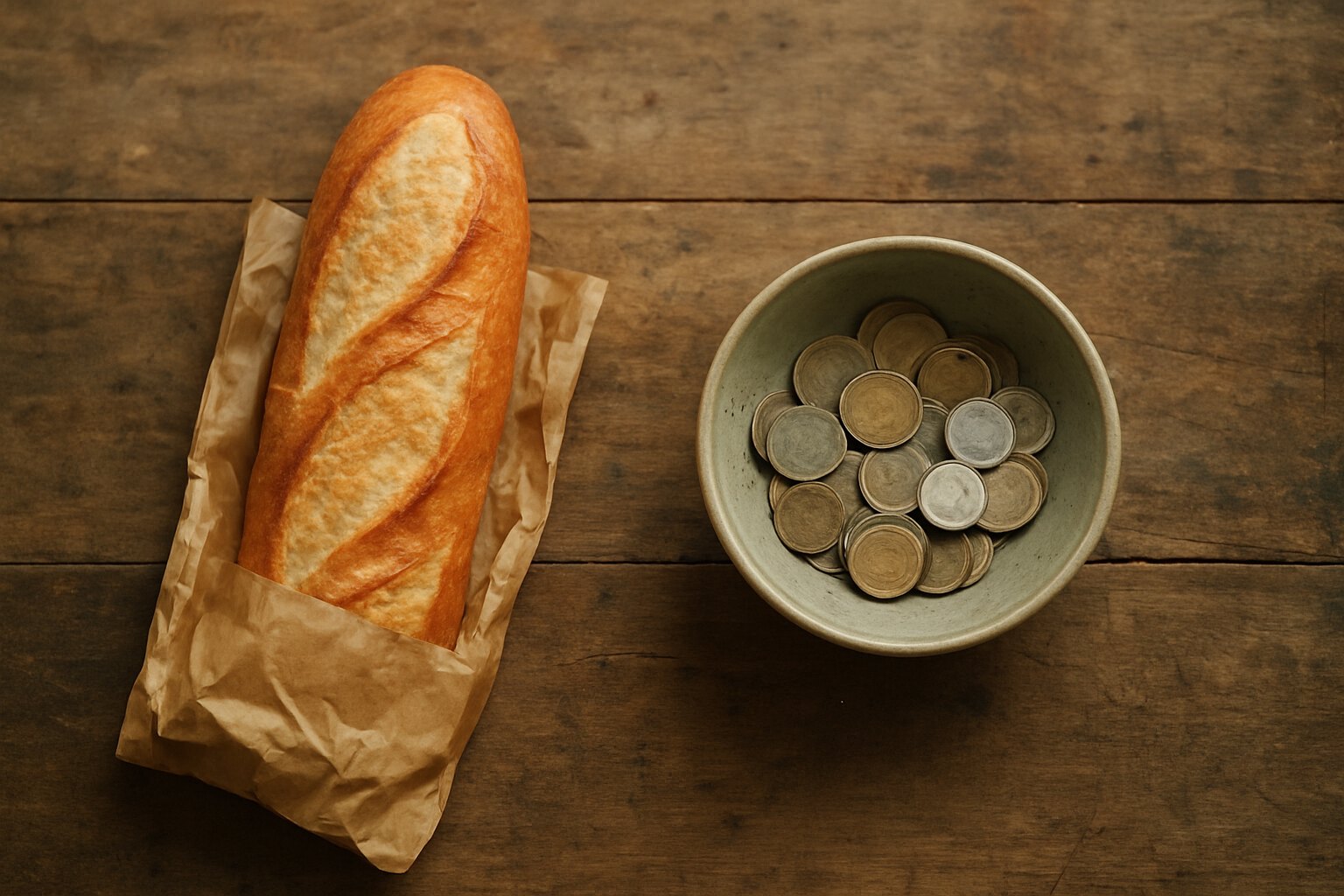
The price of a vegan banh mi: where the money actually goes
A meat banh mi from a street cart runs thirty to forty thousand dong. A vegan one from a shop runs fifty or sixty. The obvious question: you took the meat out, so why does it cost more?
The answer isn't that vegan ingredients are rare. It comes down to three things you can't see by looking at the sandwich.
1. Vegan fillings aren't as cheap as people assume
There's a common assumption that vegetables and beans cost less than meat, so vegan food should cost less. That holds for raw ingredients. But a sandwich isn't made of raw ingredients.
- Tofu is cheap. Crisp-fried tofu is not — it needs oil, someone standing at the pan, and small batches. Small batches cost more labour per portion than one big one.
- Sliced vegan cold cut is a processed product: soy protein, starch, seasoning, pressed and steamed. Several production steps, and the price reflects them. The carefully made kind — no egg, no added wheat gluten — costs more than the mass-market version.
- Tofu skin is the priciest of the group, because someone has to simmer soy milk and lift off each sheet by hand.
- Fresh herbs swing with the season and the weather. A few days of heavy rain and the price is visibly up.
And one thing almost nobody thinks about: pickles made separately without fish sauce can't be bought alongside the regular kind. Smaller batches mean a higher price per kilo.
2. There is simply more work in it
This is the biggest gap, and the hardest one to see.
A meat banh mi: the meat comes pre-cooked, the cold cut gets sliced, the pâté gets spooned out. Most of the filling is bought ready to use.
A vegan one made properly is the opposite:
- Tofu has to be pressed, cut, marinated and fried in batches.
- Pickles have to be shredded, salted, squeezed dry and steeped — and they're only good for one to four hours, so several batches a day.
- Sauces have to be made in-house, because most commercial ones contain egg or something fish-derived.
That adds up to considerably more person-hours for the same sandwich. And labour is the single largest line in a food business, larger than ingredients.
3. Staying open 24 hours is its own cost
This is the part customers almost never count. A shop open around the clock pays for hours that sell almost nothing:
- Three shifts instead of one. Someone staffs the night even when 1am to 4am brings a handful of customers.
- Power running all night — chillers, lights, fans.
- Rent is monthly, not hourly, but longer hours mean more wear and more running cost.
That cost is spread across every sandwich sold, including the ones sold at noon. Put another way, the lunchtime customer is partly paying for the shop being open at three in the morning — and the three-in-the-morning customer is the one who benefits.
What the extra buys
Fair in both directions. Paying more gets you:
- Certainty that it's actually vegan. No liver pâté, no egg sauce, no fish sauce in the pickles — the three places an ordinary cart tends to slip.
- Filling made in batches rather than sitting out since morning.
- Open 24 hours, which means being there when you need it.
Anyone who just wants a meat-free sandwich for the full moon will find the street cart cheaper, and that's a perfectly sensible choice. Anyone eating strictly vegetarian or fully plant-based will find those three slips are real.
The spread within one menu
Prices on a single menu follow exactly the same logic:
- Butter & Sugar, 28,000d — cheapest, fewest ingredients, almost no preparation.
- Sliced Vegan Cold Cut, 53,000d — filling bought in, then sliced.
- Spicy Tofu, 56,000d — more, because the tofu is fried in batches and has its own sauce.
- Combination, 59,000d — several fillings at once, so the most steps.
- Premium, 75,000d — a substantially larger portion.
Seen this way the price list isn't arbitrary — it tracks the quantity of filling and the number of preparation steps.
Buying it sensibly
- Combine orders for delivery. Orders from 500,000d within 5km ship free, so four or five people ordering together beats ordering separately.
- Split the big one. The 75,000d Premium halved between two moderate eaters costs less than two standard sandwiches.
- Use the light one for snacks. Butter & Sugar at 28,000d is enough for an afternoon gap; you don't need a fully loaded sandwich.
Five shops, all open 24 hours: 38 Le Thi Rieng, 15B Nguyen Thi Minh Khai, 2B Tran Hung Dao, 148B De Tham (District 1) and 210 Bui Van Ba (District 7). Call 0923.183.183.
Quick answers
Why does vegan banh mi cost more than the meat kind?
Three reasons: processed vegan fillings aren't as cheap as raw ingredients, preparation takes considerably more person-hours, and the cost of staying open 24 hours is spread across every sandwich sold.
Aren't vegetables cheaper than meat?
As raw ingredients, yes — but a sandwich isn't made of raw ingredients. Tofu is cheap; crisp-fried tofu in small batches is labour. Sliced vegan cold cut is a product with several production steps behind it.
What is a food business's biggest cost?
Labour, ahead of ingredients. That's why the number of preparation steps affects the price more than the cost of what goes in.
How does opening 24 hours affect the price?
Three shifts instead of one, power running all night, and more wear. That cost spreads across every sandwich — so the lunchtime customer is partly paying for the shop being open at three in the morning.
Why is Butter & Sugar so much cheaper than the rest?
Fewest ingredients and almost no preparation — just butter and sugar. The others climb with the number of steps: slicing, batch-frying, combining several fillings.
How do I keep the cost down?
Combine orders to reach the 500,000d free-delivery threshold, split a Premium between two people, and choose a light sandwich like Butter & Sugar for a snack rather than a meal.

New to Saigon and eating vegan: three areas worth knowing
Saigon has plenty of vegetarian places, but they aren't spread evenly. Knowing three areas and two time patterns makes the first month far easier.
Ordering through a delivery app or calling the shop: what actually differs
Two ways to order the same sandwich, differing in price, in speed, and most importantly in whether you can explain what vegan means to you.
Eating vegan at 2am around Bui Vien and De Tham: how to get there
The backpacker quarter stays awake until dawn, but most of what's open doesn't serve vegan food. Here's how to get from the middle of it to something
Banh mi, rice or noodle soup: choosing by the clock and by appetite
Three vegan meals that solve three different problems. Choosing by the time of day and by what you're about to do works better than choosing by cravin
 ›
×

Vegan banh mi and plant-based coffee in Ho Chi Minh City. Five shops open 24/7 including Sundays and holidays. Free delivery within 5km on orders from 500,000d.
Brand strategy by Ten Mien Dang Cap
© 2026 Bánh Mì XANH. All rights reserved.