
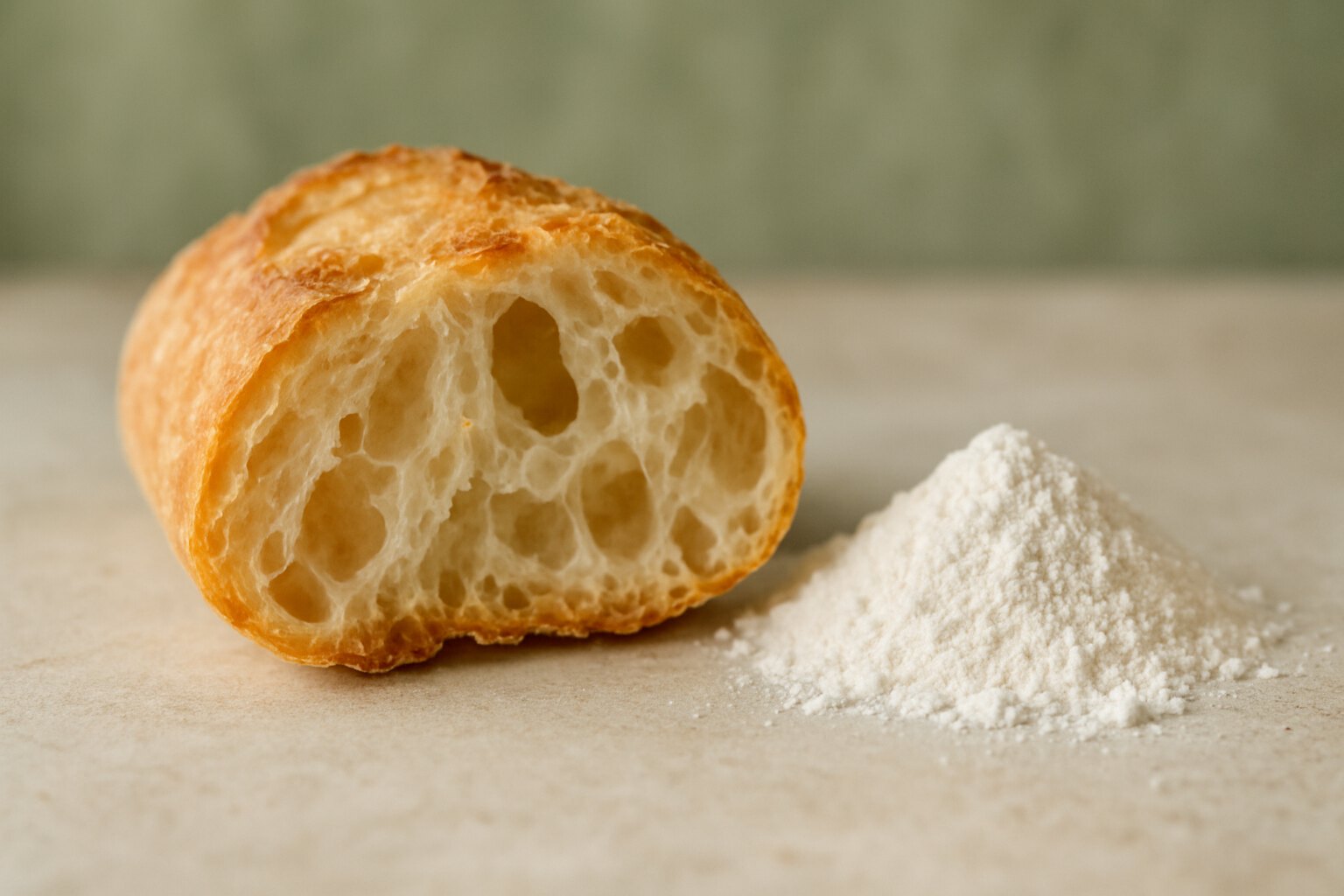
Vegan banh mi and gluten: why there is no gluten-free version, and what to eat instead
The question comes to the counter fairly regularly, usually from foreign customers and lately from Vietnamese ones too: does vegan banh mi contain gluten? The short answer is not a comfortable one: yes, and there is no version that does not.
The reasons are worth setting out, because behind the question sits a fairly common confusion.
Vegan and gluten-free are unrelated
Eating vegan is about where an ingredient comes from — nothing from animals. Gluten-free is about one particular plant protein found in wheat, barley and rye.
Gluten is a protein from plants. Which means it is entirely vegan, and a strictly vegan dish can be full of it. Conversely a piece of beef contains no gluten at all and is not remotely vegan. The two axes are independent.
The confusion arises because both sit in the same “healthy eating” corner of a supermarket, so people merge them into one idea.
Why a banh mi cannot simply drop the gluten
Gluten is not an additive that could be left out. It is the thing that creates the structure of the loaf.
When wheat flour is mixed with water, two proteins in the flour link into an elastic network — that network is gluten. Yeast produces gas, the network traps it, the dough rises and holds its shape. Baked, the network sets into the open crumb and the thin crisp crust that defines Vietnamese bread.
Remove the gluten and nothing holds the gas. Gluten-free flour bakes into a dense, crumbly block that falls apart when sliced. Getting anywhere near the right structure means rice flour, potato flour and tapioca starch plus a thickener such as xanthan gum — and the result is a different thing entirely, not a Vietnamese loaf.
Could it be done? Yes. But it needs a separate oven, a separate flour area and separate equipment, because a little airborne wheat dust defeats the whole purpose. That is why genuinely gluten-free bakeries are specialists rather than ordinary bakeries with an extra line.
Who genuinely needs to avoid it, and who does not
There are three very different groups here, and treating them as one gets all three wrong:
Coeliac disease
An autoimmune condition. Gluten causes the immune system to attack the lining of the small intestine. This group must avoid it absolutely, including traces from a shared board, knife or oven. For them, “scoop out some of the crumb” means nothing.
Non-coeliac gluten sensitivity
Bloating, fatigue, mental fog after eating it — but tests do not show coeliac disease. This group can usually tolerate small amounts, with a threshold that differs from person to person and has to be found by trial.
Avoiding gluten as a trend
The largest group. No diagnosis, avoiding it because it is said to be better. For them the gluten in a loaf is not the problem — and swapping bread for something with more sugar works against the intention.
If you suspect you belong to the first two groups, get tested before cutting out a whole food group, because dropping wheat long-term without replacing it properly tends to leave people short of fibre and B vitamins. This is general information and does not replace a doctor's diagnosis.
Eating vegan and gluten-free
Take bread out and a vegan diet still has plenty left, most of it familiar Vietnamese food:
- Bún, phở, hủ tiếu, bánh cuốn, bánh xèo — all made from rice flour, no gluten. This is the fortunate part of Vietnamese cooking: most noodle and batter dishes are rice-based.
- Rice and sticky rice — both gluten-free.
- Tofu, beans and pulses, mushrooms, vegetables — gluten-free, and the main protein group of a vegan diet.
Two traps that catch people new to avoiding gluten:
- Wheat gluten (mì căn) — a familiar vegan staple, but it is wheat gluten, pressed. It is the single most gluten-rich thing on a vegan plate, and many mock-meat dishes are made from it.
- Soy sauce — most fermented soy sauce has wheat in it. Anyone avoiding gluten strictly has to find one that states no wheat.
How it stands at the shops
Plainly: Banh Mi XANH has no gluten-free version, and the crust is wheat, so every loaf contains gluten. All five — Thập Cẩm at 59,000d, Chả Lát Chay at 53,000d, Đậu Hũ Cay at 56,000d, Bơ Đường at 28,000d and Thượng Hạng Premium at 75,000d — are fully vegan and all contain gluten. The two do not travel together.
The drinks are another matter: Black Coffee at 35,000d, Nut Milk Coffee at 45,000d, Jasmine Lemon Tea at 36,000d, Nut Milk Bubble Tea at 45,000d and the Brown Sugar version at 48,000d — the pearls are tapioca starch, not wheat. Anyone avoiding gluten can drink them, though at coeliac level it is worth asking the staff about shared equipment.
The five shops are open 24 hours: 38 Lê Thị Riêng, 15B Nguyễn Thị Minh Khai, 2B Trần Hưng Đạo and 148B Đề Thám in District 1, and 210 Bùi Văn Ba in District 7. Call 0923.183.183; orders from 500,000d within 5km are delivered free.
Quick questions
Is vegan food automatically gluten-free?
No. Gluten is a plant protein found in wheat, so a completely vegan dish can be full of it. The two are unrelated; they only get merged because they sit in the same part of a supermarket.
Can I scoop out the crumb to reduce the gluten?
For someone merely cutting down, yes, a little — less wheat eaten. For coeliac disease it is meaningless: the crust is wheat too, and a very small amount is enough to trigger a reaction.
Does mì căn contain gluten?
Yes, more than anything else. Mì căn is wheat gluten pressed into a block. This is the trap people new to avoiding gluten fall into most often, because it is such a familiar vegan ingredient.
Are bubble tea pearls gluten-free?
Yes — they are tapioca starch, not wheat. But at coeliac level it is worth asking about shared equipment behind the counter.
Does soy sauce contain gluten?
Most fermented soy sauce does contain wheat. Anyone avoiding it strictly needs one that states no wheat on the label — do not assume soy sauce is safe.
I think gluten does not agree with me. What should I do?
Get tested before cutting out a whole food group. Dropping wheat long-term without replacing it properly tends to leave people short of fibre and B vitamins. This is general information, not a diagnosis.

New to Saigon and eating vegan: three areas worth knowing
Saigon has plenty of vegetarian places, but they aren't spread evenly. Knowing three areas and two time patterns makes the first month far easier.
The price of a vegan banh mi: where the money actually goes
Vegan banh mi usually costs more than the meat kind, and it isn't because vegan food is scarce. It comes down to three things you can't see by looking
Banh mi, rice or noodle soup: choosing by the clock and by appetite
Three vegan meals that solve three different problems. Choosing by the time of day and by what you're about to do works better than choosing by cravin
Eating vegan at 2am around Bui Vien and De Tham: how to get there
The backpacker quarter stays awake until dawn, but most of what's open doesn't serve vegan food. Here's how to get from the middle of it to something
 ›
×

Vegan banh mi and plant-based coffee in Ho Chi Minh City. Five shops open 24/7 including Sundays and holidays. Free delivery within 5km on orders from 500,000d.
Brand strategy by Ten Mien Dang Cap
© 2026 Bánh Mì XANH. All rights reserved.