
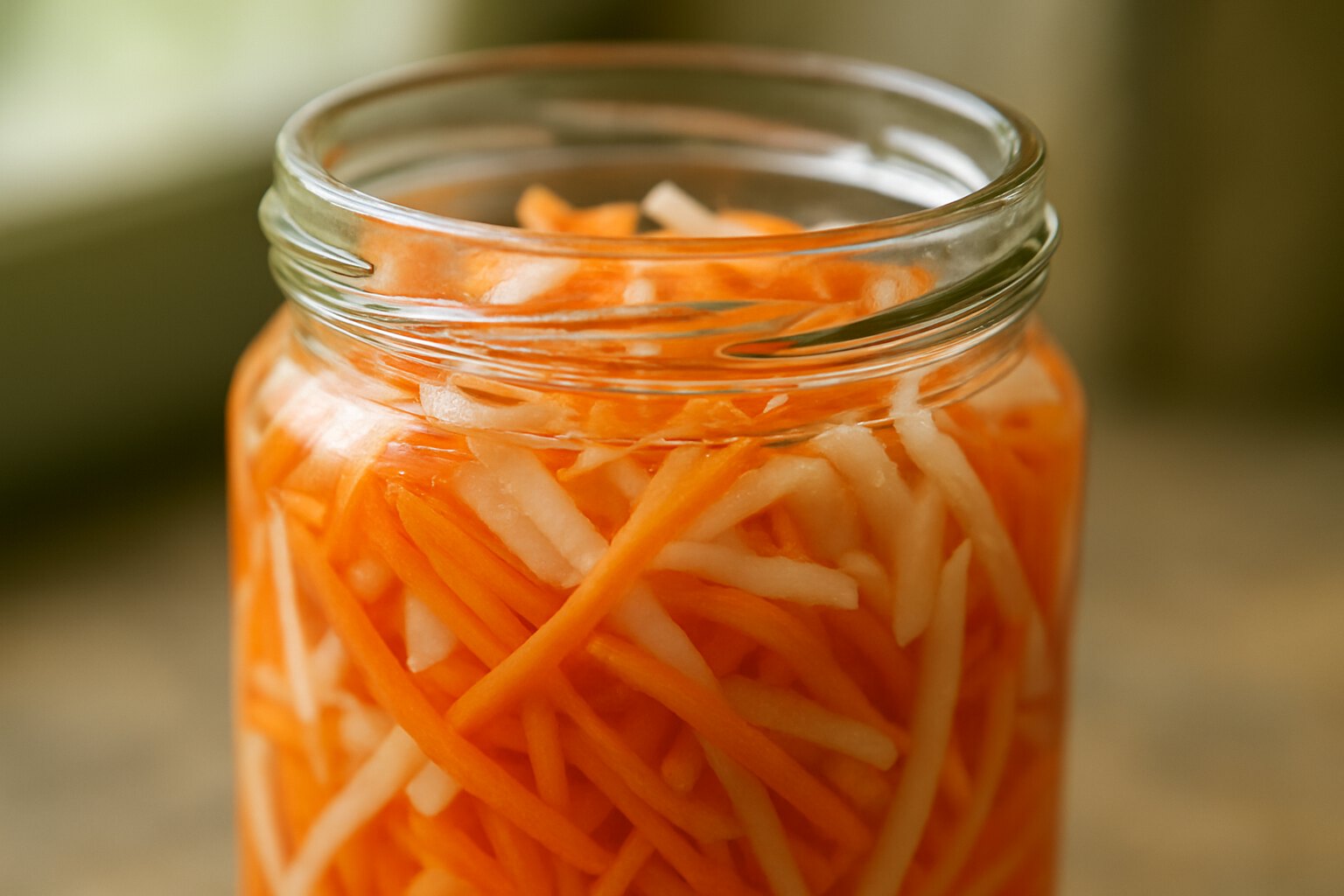
The pickles in a banh mi: how long to steep, and why there is no fish sauce in ours
Of everything in a banh mi, the pickles get the least attention and do the most work. Leave them out and the loaf is cloying by the third bite. Put too many in and it turns sharp and wet. They are also where a loaf marked vegan quietly stops being vegan.
What the pickles are doing
Three jobs, all of them real:
- Cutting richness. The fillings are fried and the sauce is rich. Acidity clears the palate after each bite, so the fifth mouthful is as good as the first. Without it, half a loaf already feels heavy.
- A second kind of crunch. The crust is crisp in a dry, shattering way. Pickled carrot is crisp in a wet, snapping way. Two different crunches in one mouthful is part of what makes a banh mi more interesting than a sandwich.
- Keeping the crumb from drying. A little moisture from the pickles stops the crumb going dry — but only a little.
How long to steep
This is where home versions most often go wrong, because people assume longer means better. In fact it is a curve with a peak:
- Under 30 minutes — not yet through. It still eats as raw carrot, sharp, with the sourness only on the surface.
- 1 to 4 hours — the best window. The shreds have softened at the outside while the core is still crisp, and the sweet-sour has reached the middle. This is what a shop aims for.
- Overnight to 3 days — still good, slightly less crisp, deeper flavour. Plenty of people prefer this.
- After 5 to 7 days — going limp, the crunch gone. Edible, but no longer doing its job.
A trick few people use that changes everything: salt them before steeping. Scatter salt over the shredded carrot and daikon, leave ten minutes, squeeze gently and drain. This draws water out of the shreds, so when they go into the brine they absorb it rather than dilute it. The result is crisper and quicker to take, and the loaf ends up less wet.
Why many recipes use fish sauce — and why ours does not
The traditional pickle brine at many stalls carries a little fish sauce. The reason is technical rather than casual: fish sauce brings umami and a rounded saltiness that takes the edge off the acidity and gives it a finish. Without it, vinegar and sugar alone taste somewhat flat — sour, then sweet, then nothing.
For a vegan loaf that is a genuine problem, because fish sauce is an animal product. The quantity is small and it is never written on a board, so someone eating vegetarian full-time can easily eat it without knowing. At Banh Mi XANH the pickles are vinegar, sugar, salt and water — no fish sauce.
So what replaces the umami? Several familiar options in a vegan kitchen, all plant-based:
- Soy sauce — a few drops in the brine. Deep flavour, but it darkens the shreds, so use little.
- A little dried shiitake soaking water — very high in umami and the closest stand-in for the role fish sauce played, without changing the colour.
- More salt and slightly less sugar — the simplest route. The flavour differs from fish sauce but it is clean and straightforward.
Making vegan pickles at home
An easy ratio, no scales needed: 1 vinegar — 1 sugar — 2 water, plus a pinch of salt.
- Shred the carrot and daikon to matchstick size. Too thick and they never take; too fine and they go soft quickly.
- Salt them, wait ten minutes, squeeze gently and drain.
- Mix vinegar, sugar, water and salt until the sugar dissolves. No heating needed.
- Pack into a jar, cover with the brine, close the lid. Ready in an hour.
Three common failures: not draining (the brine is diluted and the shreds go soft), boiling the brine and pouring it hot (this cooks the shreds and the crunch is gone immediately), and using old daikon (harsh and fibrous, and no amount of steeping rescues it).
Daikon carries a distinctive sharp smell that spreads to everything else in a fridge over a week. Keep it sealed, in its own jar.
Ordering at the shop
Pickles come in Thập Cẩm at 59,000d, Chả Lát Chay at 53,000d and Đậu Hũ Cay at 56,000d. If you want more or fewer, say so when ordering — this is adjusted at the counter with no waiting. Bơ Đường at 28,000d has none, since it is the sweet loaf.
The five shops are open 24 hours: 38 Lê Thị Riêng, 15B Nguyễn Thị Minh Khai, 2B Trần Hưng Đạo and 148B Đề Thám in District 1, and 210 Bùi Văn Ba in District 7. For delivery call 0923.183.183; orders from 500,000d within 5km are delivered free.
One note for anyone carrying a loaf: the pickles are the main source of moisture in it, so if you will not eat for a few hours, ask for them separately and add them on arrival.
Quick questions
Do the pickles at Banh Mi XANH contain fish sauce?
No — vinegar, sugar, salt and water only. Many places add a little fish sauce for a rounder flavour, but that is an animal product and the loaf is then no longer fully vegan.
How long until they are ready?
An hour is enough, and one to four hours is the best window — soft outside with a crisp core. Overnight is still good, deeper in flavour but slightly less crisp.
Why salt them before steeping?
To draw water out of the shreds. Drained shreds absorb the brine instead of diluting it, so they are crisper, take flavour faster, and leave the loaf less wet. Skipping this is why home pickles often go soft.
How long do they keep in the fridge?
Five to seven days and they are still edible but limp, no longer doing their job in a loaf. The first three days are the best of it.
What if I have no daikon?
Carrot alone works; it is sweeter and lacks daikon's slight sharpness. Shredded kohlrabi also substitutes well and stays crisp longer.
Can I ask for more or fewer pickles?
Yes — say so when ordering and the staff adjust it at the counter. Bơ Đường has none, because it is the sweet loaf.

What to eat alongside a banh mi to make it a complete meal
A sandwich has starch and protein but is short on a few things. Adding one or two items is the difference between a stopgap and a proper meal.

Salt, pepper and sugar in a vegan sandwich: why vegan food tastes flat
Vegan food gets called bland, but not because it's under-salted. The cause is something plant ingredients lack — and adding salt is the wrong fix.
Ordering Spicy Tofu when you can't take heat: four adjustments
The heat in a sandwich doesn't come from one place, so it can be dialled down by degrees rather than being all-or-nothing.

How much is in one banh mi, and how long does it hold you
A simple question with a three-part answer — and the part that matters most isn't the weight of the sandwich.
 ›
×

Vegan banh mi and plant-based coffee in Ho Chi Minh City. Five shops open 24/7 including Sundays and holidays. Free delivery within 5km on orders from 500,000d.
Brand strategy by Ten Mien Dang Cap
© 2026 Bánh Mì XANH. All rights reserved.