
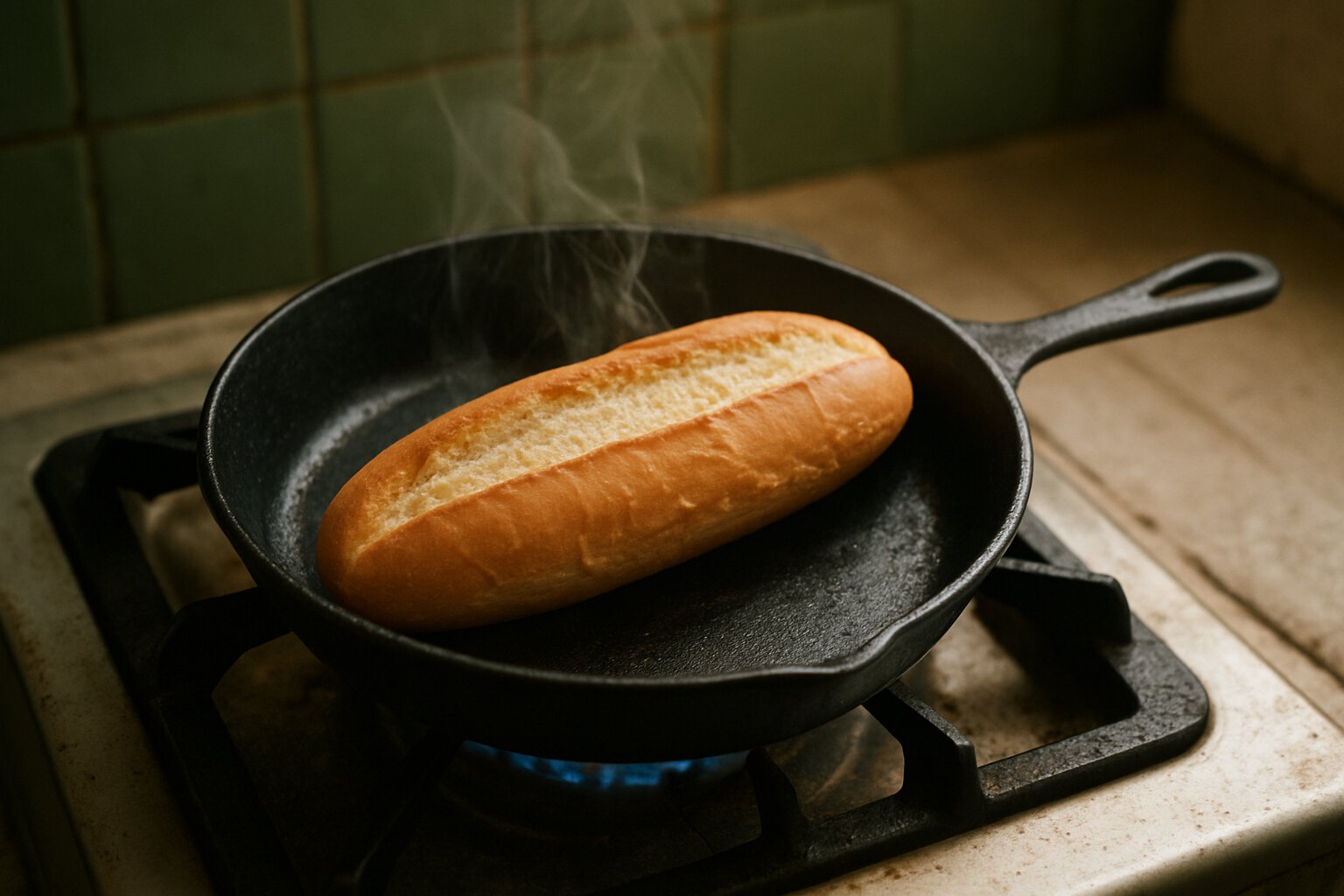
Day-old banh mi: how to bring the crust back
You bought a vegan banh mi last night, could not finish it, and put it in the fridge. This morning: the crust is limp, it does not crack when you bite, and the crumb has gone slightly tough. Most people conclude the bread has dried out and put it in the microwave to “soften it up” — which is the step that finishes it off.
The problem is a misreading of what has happened to the loaf.
The crust goes soft because it ABSORBS moisture, not because it dries
A banh mi crust is crisp because it is drier than the crumb inside. Left to cool in a sealed bag or in the fridge, water vapour from the crumb and from the filling has nowhere to escape to, so it moves back into the crust. A crust that absorbs moisture loses its crispness — the same mechanism that softens rice paper left out in humid weather.
There is a second thing few people know: the fridge ages bread faster than the counter does. Starch in the crumb recrystallises fastest at around 0–7°C, which is exactly the temperature of a fridge shelf. A loaf that spends one night in the fridge is about as stale as one left out for two or three days.
Understand those two and the fix explains itself: you have to drive moisture out of the crust and heat the crumb enough for the starch to soften again. A microwave does precisely the opposite — it turns the water in the bread to steam, the steam settles on the crust, and the loaf comes out hot but limp, then turns rubbery as it cools.
Three methods, in the order worth trying
1. A dry pan — best, and needs no equipment
Split the loaf, lay it cut-side down in a dry pan over medium heat, no oil. Two to three minutes and the cut face seals and smells of baking bread. Turn it over, put a lid on for one minute so the crumb heats through, then take the lid straight off.
The common mistake: putting the lid on at the start. Cover it early and the steam circulates inside the pan and goes back into the crust, undoing the whole exercise. The lid belongs only in the last minute, and comes off the moment the loaf is hot.
2. An air fryer — the most convenient if you have one
180°C for three to four minutes, no oil spray needed. Hot air moving around the loaf drives moisture out of the crust quickly, which is what an air fryer does best. Add a minute for a large loaf like Thượng Hạng Premium.
Do not wrap it in foil. Wrapping traps the steam, and you are steaming rather than toasting.
3. An oven — slower but the most even for several loaves
200°C for five minutes, directly on the rack rather than on a tray. This is the method for reheating three or four loaves for a household; for a single loaf, waiting for an oven to heat is not worth it.
Which fillings to take out first
This is where a vegan banh mi differs from a meat one, and where it most often goes wrong:
- Fresh herbs and cucumber — always take them out. Heat makes them release water, softening the crust again the moment it has crisped, and the greens themselves wilt to nothing.
- Pickles — take them out. Pickled carrot releases its sour liquid under heat, which soaks into the crumb and turns sharp.
- Fried tofu — leave it in. It crisps up again to a degree. This is the filling that handles heat best.
- Vegan cold cut — leave it in, no problem. Pressed soy takes heat well and smells better for it.
- Butter and sugar — take it out if you are using a pan, because melted sugar catches and burns. In an air fryer it can stay.
The tidiest approach: open the loaf, tip the greens and pickles onto a plate, reheat the loaf with the heat-tolerant fillings, then put the greens back. Thirty extra seconds, and it makes all the difference.
Storing it so there is less to rescue
If you know in advance the loaf is staying overnight, dealing with it that evening is far easier:
- Do not put a whole filled loaf in the fridge. Take the greens and pickles into their own container and keep the loaf and dry fillings separate. Assemble in the morning and the crust is noticeably better.
- Wrap in paper, not plastic. Paper lets some moisture escape; a plastic bag holds it in and the crust is limper by morning.
- Leave it out rather than in the fridge for a single night in a house that is not too warm. The fridge is precisely the temperature range that stales bread fastest.
- The freezer, though, is fine for several days — freezing stops starch recrystallisation altogether. Thaw at room temperature and reheat in a dry pan, and the loaf is close to new.
Or simply buy a hot one
Banh Mi XANH is open 24 hours at all five shops, so there is no hour of the day that forces you to eat cold bread: 38 Lê Thị Riêng, 15B Nguyễn Thị Minh Khai, 2B Trần Hưng Đạo and 148B Đề Thám in District 1, and 210 Bùi Văn Ba in District 7. Bread is baked in batches and never sits on the shelf more than four hours.
For delivery, call 0923.183.183; orders from 500,000d within 5km arrive free. Ordering for the household in one go both clears that threshold and saves you storing leftovers.
Quick questions
Why does a microwave make bread rubbery?
It turns the water inside the bread to steam, and that steam settles on the crust, so the loaf comes out hot but limp. As it cools the crumb turns rubbery, because the starch has been heated and then cooled quickly. Crispness needs dry heat, not microwaves.
Does bread keep better in the fridge or on the counter?
On the counter, for a single night. Starch recrystallises fastest at around 0–7°C — fridge temperature — so one night chilled ages a loaf about as much as two or three days out. For longer than a few days, the freezer is the right place.
Can I reheat the loaf with the salad still in it?
You can, but it is much worse. Greens and pickles release water under heat, softening the crust the moment it crisps, and the greens wilt. Tip them onto a plate first and put them back after — thirty seconds of work.
Does an air fryer need an oil spray?
No. The crust is dry enough already; oil only makes it greasy and burns the thin spots. 180°C for three to four minutes, and no foil.
Can a reheated loaf be reheated again?
Once more, but each round costs the crumb more water, so by the third it is hard and dry. Better to reheat only what you are about to eat.
Does a big Thượng Hạng Premium reheat differently?
Only in timing: the filling is thicker, so it needs about a minute more to heat through the middle. The method is identical — what matters is still taking the greens out and not covering it from the start.

New to Saigon and eating vegan: three areas worth knowing
Saigon has plenty of vegetarian places, but they aren't spread evenly. Knowing three areas and two time patterns makes the first month far easier.
The price of a vegan banh mi: where the money actually goes
Vegan banh mi usually costs more than the meat kind, and it isn't because vegan food is scarce. It comes down to three things you can't see by looking
Banh mi, rice or noodle soup: choosing by the clock and by appetite
Three vegan meals that solve three different problems. Choosing by the time of day and by what you're about to do works better than choosing by cravin

Eating vegan at 2am around Bui Vien and De Tham: how to get there
The backpacker quarter stays awake until dawn, but most of what's open doesn't serve vegan food. Here's how to get from the middle of it to something
 ›
×

Vegan banh mi and plant-based coffee in Ho Chi Minh City. Five shops open 24/7 including Sundays and holidays. Free delivery within 5km on orders from 500,000d.
Brand strategy by Ten Mien Dang Cap
© 2026 Bánh Mì XANH. All rights reserved.