
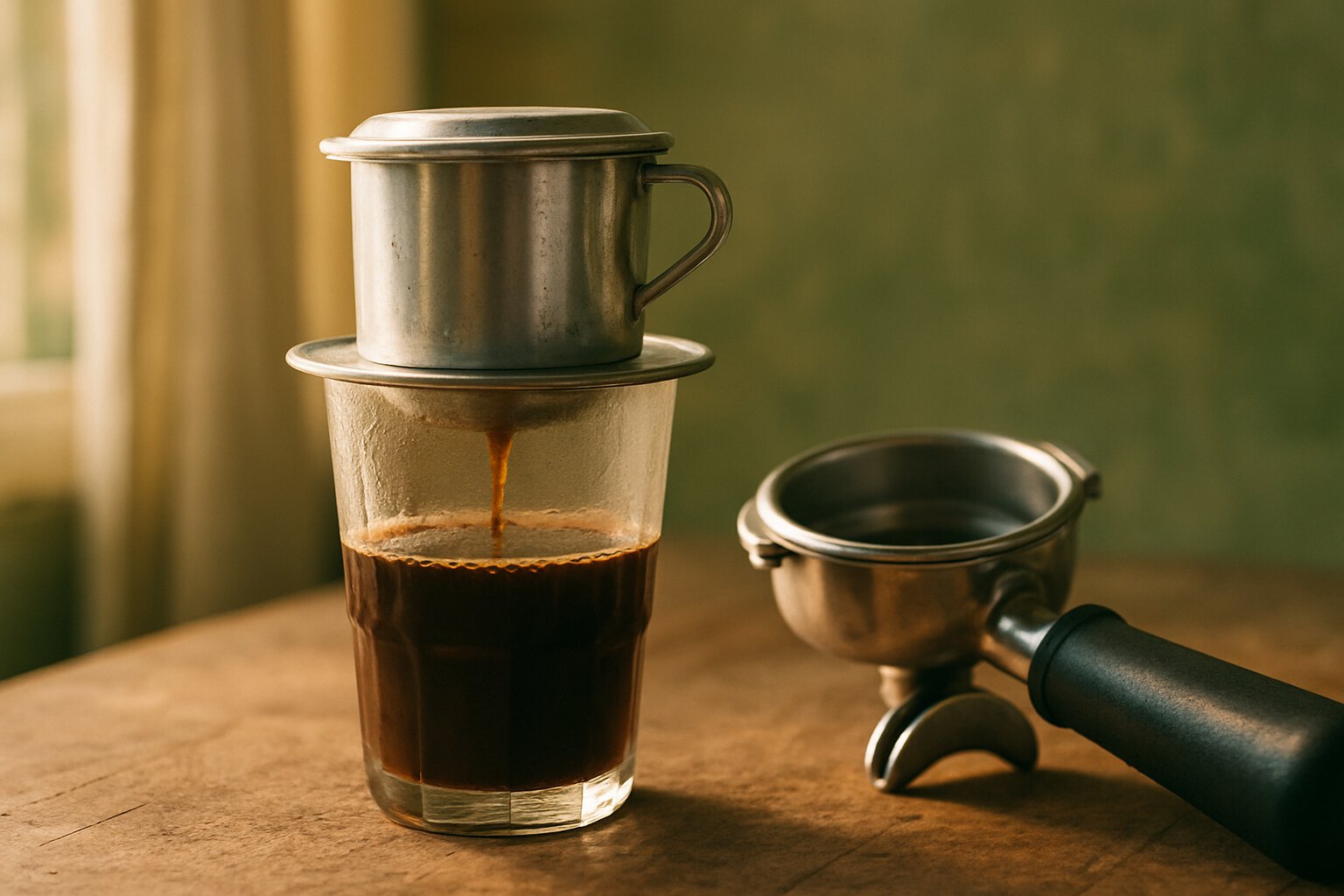
Phin coffee versus machine coffee: what changes when nut milk goes in
The same carton of nut milk, the same person pouring. Into a phin coffee it goes smooth and rich. Into an espresso it curdles. Most people conclude the milk has gone off, or that this brand is poor.
Neither. The two methods produce fundamentally different liquids, and nut milk reacts to them differently.
Three differences that decide it
1. Acidity
The biggest one. Vietnamese phin coffee is almost always made from dark-roasted beans. The longer the roast, the more the acids in the bean break down, so the resulting coffee is less sour.
Machine coffee in a specialty café is usually a lighter roast, keeping the fruity acidity — which is deliberate. But that acidity is exactly what makes the protein in nut milk coagulate.
Which means: a Vietnamese-style nut milk coffee is safer than a specialty nut milk latte, counter-intuitive as that sounds.
2. Concentration
A shot of espresso is 25–30ml of very concentrated liquid. A phin drips out 40–50ml, but far less concentrated than the same volume of espresso.
Concentrated espresso means concentrated acid. Pour milk into a dense pool of acid and the first milk to touch it takes the full force, and sets on the spot before it can disperse.
3. Temperature and time
Espresso leaves the machine at around 90°C, in a matter of seconds. A phin drips for four to six minutes, cooling as it goes — by the time you drink it, usually 60–70°C.
The gap between cold milk and hot coffee is the second cause of splitting. A phin is cooler, and therefore gentler.
The comparison in brief
| Phin | Machine | |
| Roast | Usually dark, low acid | Usually lighter, more acid |
| Concentration | Moderate | Very high |
| Temperature at the milk | 60–70°C | Around 90°C |
| Risk of splitting | Low | Considerably higher |
| Brew time | 4–6 minutes | Under a minute |
How the flavour differs
Beyond splitting, the two give two kinds of cup:
- Phin — water passes slowly through the grounds, extracting more bitterness and body. A heavy, dense cup with a long finish. This is the style that suits rich milk and sugar, which is how Vietnamese milk coffee came to be what it is.
- Machine — high pressure, fast extraction, more of the volatile aromatics retained. A brighter cup with crema, more complex but thinner.
Neither is better. They serve two different tastes, and nut milk naturally suits the phin style, since both lean towards depth and richness.
Choosing at home
With a phin
Splitting is barely a concern. Just avoid pouring fridge-cold milk into a freshly finished glass. Ten minutes out of the fridge is enough.
With a machine or a light roast
Three things, in order of importance:
- Pour the coffee into the milk, not the milk into the coffee. The acid is diluted gradually instead of hitting the first milk in.
- Choose oat or cashew, or one labelled for baristas. Soy tastes best but splits most readily in this situation.
- Warm the milk first if making it hot. Narrowing the temperature gap removes most of the risk.
Making it iced
Ice first, then the coffee to bring the temperature down, then the milk. This is why iced nut milk coffee splits far less than the hot version from the same ingredients.
At the shops
Nut Milk Coffee at 45,000d is made to a fixed ratio, so there is nothing to judge. To adjust it yourself, order Black Coffee at 35,000d and ask for nut milk on the side — that also lets you set the strength.
To avoid the acidity question entirely, Nut Milk Bubble Tea at 45,000d or the Brown Sugar version at 48,000d — tea is far less acidic than coffee, so it essentially never splits.
The five shops are open 24 hours: 38 Lê Thị Riêng, 15B Nguyễn Thị Minh Khai, 2B Trần Hưng Đạo and 148B Đề Thám in District 1, and 210 Bùi Văn Ba in District 7. Call 0923.183.183; orders from 500,000d within 5km are delivered free.
Quick questions
Why does phin coffee split nut milk less?
Three reasons together: dark roast means less acid, the brew is less concentrated than espresso so the acid is not dense, and it cools over four to six minutes so it meets the milk at 60–70°C rather than 90°C.
Is a light roast worse?
No, just different. A light roast keeps fruity acidity, which is intended. But that acidity coagulates the protein in nut milk, so it is fussier about the milk.
Coffee into milk, or milk into coffee?
Coffee into milk. The acid is diluted gradually in a larger body of milk instead of concentrating on the first milk it touches.
Which nut milk suits machine coffee best?
Oat or cashew, or one labelled for baristas. Soy tastes best but is high in protein and therefore splits most readily against acid.
Does iced coffee split less?
Yes, if you put the ice in first and then the coffee and milk. The coffee drops in temperature immediately, narrowing the gap with the milk.
Which is better, phin or machine?
Two different tastes. Phin gives a heavy, dense cup with a long finish that suits rich milk and sugar. A machine gives a brighter cup with more aromatics and crema, but thinner.

Hot or iced: which drinks suit which, and why
Not every drink works both ways. Temperature changes flavour, and some drinks lose their best quality entirely once ice goes in.

Caffeine in milk tea versus coffee: a sense of the numbers
Milk tea gets treated as a light drink, fine in the evening. But tea contains caffeine too, and some cups carry more than a small coffee.

Cubed, crushed or block ice: what it does to a drink
Same drink, different ice, and both the dilution rate and the drinking experience change. An overlooked variable with a visible effect.

Jasmine in lemon tea: real flowers or added flavouring, and how to tell
Real jasmine tea is scented with fresh flowers over repeated rounds — laborious work. Flavoured tea is tea sprayed with scent. Three signs separate th
 ›
×

Vegan banh mi and plant-based coffee in Ho Chi Minh City. Five shops open 24/7 including Sundays and holidays. Free delivery within 5km on orders from 500,000d.
Brand strategy by Ten Mien Dang Cap
© 2026 Bánh Mì XANH. All rights reserved.