
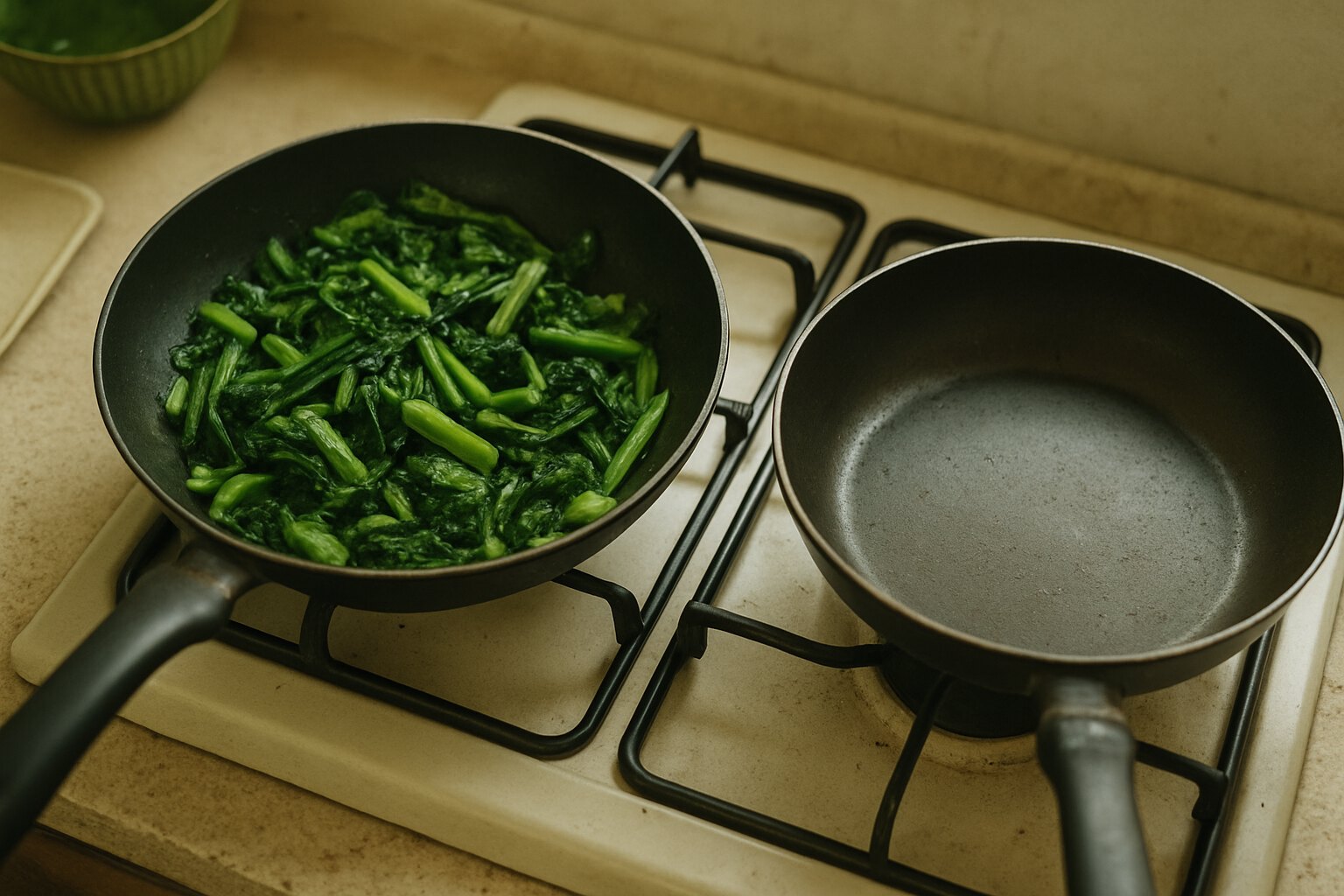
One kitchen, two meals: cooking vegan for yourself and meat for the family
A vegetarian living with a meat-eating family runs into the same thing: one kitchen, two ways of eating. Cooking twice is exhausting; cooking together mixes things. This is solved by arranging the kitchen, not by persuading anyone.
First: how much mixing actually matters
Answer this before rearranging anything, because each level takes different effort.
- Periodic vegetarian — usually just needs a separate dish, without much concern about shared pans.
- Lifelong vegetarian — most want to avoid obvious meat and fish, but a washed pan is acceptable.
- Fully plant-based — usually needs separate utensils for things that don't wash clean, frying oil above all.
No level is more correct than another. But telling whoever does the main cooking which level you're at prevents a lot of misunderstanding — and the situation where a dish is finished before anyone realises you can't eat it.
Separating utensils: only three things matter
You don't need a second set of pots. These three are worth separating because washing doesn't fully clear them:
- The chopping board. Knife cuts in a wooden board hold smell and meat juices. Buying a second plastic board in a different colour is the tidiest fix — different colour so nobody grabs the wrong one.
- Frying oil. Oil that just fried fish will flavour tofu immediately. In a household that fries often, keep a small separate jar.
- Tasting spoons and serving chopsticks. The most forgotten one — tasting a meat soup and then stirring the vegetarian pot with the same spoon.
Pots, pans and crockery, washed properly, are fine to share for most people. Fish sauce and shrimp paste are worth keeping in their own spot, since the smell lingers and they're easy to reach for by mistake.
Order of cooking: vegan first
The simplest and most effective habit: do the vegetarian part first, the meat part after.
The reason: at the start the kitchen is clean, with no animal fat and no smell. Done the other way round you have to wash mid-cook — and washing mid-cook is something everyone tends to do hastily.
A sequence that works in a home kitchen:
- Prep the vegetables for both meals together — this part doesn't differ.
- Cook the vegetarian dish, plate it, cover it.
- Rinse the utensils.
- Cook the meat dish.
One pot, two meals
This is where the most work is saved, and the least-used trick. The principle: cook the base vegetarian, add the animal protein later.
- Soup. Make a vegetable soup without fish sauce, ladle out one bowl, then season and add to the rest.
- Stir-fried greens. Stir-fry plain, without garlic if needed, split in two, and add fried garlic or meat to the family's half.
- Fried rice. Fry the rice with vegetables first, set some aside, then add egg or sausage to the remainder.
- Noodle soup. A vegetable broth made separately works for everyone; the meat goes into individual bowls.
This cuts cooking time sharply, and more importantly it means everyone eats the same dish rather than each person having their own — which affects the feel of a family meal more than people expect.
Days there's no time to cook
Not every day allows for arranging things. A few practical outs:
- Prep protein for two or three days. Marinated tofu, pre-cooked pulses — at mealtime it's just frying or mixing.
- Buy the vegetarian portion out for one person while the household cooks normally. Cheaper and faster than cooking a whole separate pot for one.
- On busy days, simplify rather than insisting on a full spread. A loaded vegan banh mi is a complete meal and doesn't need the stove on.
Five shops, all open 24 hours: 38 Le Thi Rieng, 15B Nguyen Thi Minh Khai, 2B Tran Hung Dao, 148B De Tham (District 1) and 210 Bui Van Ba (District 7). Call 0923.183.183; orders from 500,000d within 5km ship free.
Quick answers
Do I need a separate set of pots?
No. Only three things are worth separating because washing doesn't clear them: the chopping board, frying oil, and tasting spoons and serving chopsticks. Washed pots and crockery are fine to share for most people.
Should I cook the vegetarian or the meat dish first?
Vegetarian first, while the kitchen is still clean and free of animal fat. The other way round forces washing mid-cook, which everyone tends to do hastily.
How do I cook once and feed both?
Cook the base vegetarian and add protein after: ladle out a bowl of unseasoned vegetable soup first, set aside vegetable fried rice before adding egg, make a vegetable broth everyone can eat.
Why does the chopping board matter more than the pot?
Because knife cuts in a wooden board hold smell and meat juices and don't wash clean, while smooth pot surfaces do. A second plastic board in a different colour is enough.
Which utensil is most often forgotten?
The tasting spoon and serving chopsticks — tasting a meat soup and then stirring the vegetarian pot with the same spoon is very common.
What about days with no time to cook?
Prep protein for two or three days ahead, or buy the vegetarian portion out for one person while the household cooks normally — cheaper and faster than a separate pot for one.

On long-term medication and want to eat vegan: what to ask your doctor
Changing your diet during treatment is a conversation to have with a doctor. This article gives no medical advice — it helps you prepare the right que

Eating vegan through the Vu Lan month: a whole month or a few days
The hard decision isn't whether to eat vegetarian but which level you can hold to the end of the month. How you plan meals decides that.
Stopped eating vegan and want to go back: where to restart
Stopping partway is very common. Going back works better if you look at why it broke down last time instead of restarting the same way.
Training hard on a vegan diet: arranging meals around the session
The real question isn't whether you can train on plants. It's how to arrange meals around a session so you have enough energy without feeling heavy.
 ›
×

Vegan banh mi and plant-based coffee in Ho Chi Minh City. Five shops open 24/7 including Sundays and holidays. Free delivery within 5km on orders from 500,000d.
Brand strategy by Ten Mien Dang Cap
© 2026 Bánh Mì XANH. All rights reserved.