
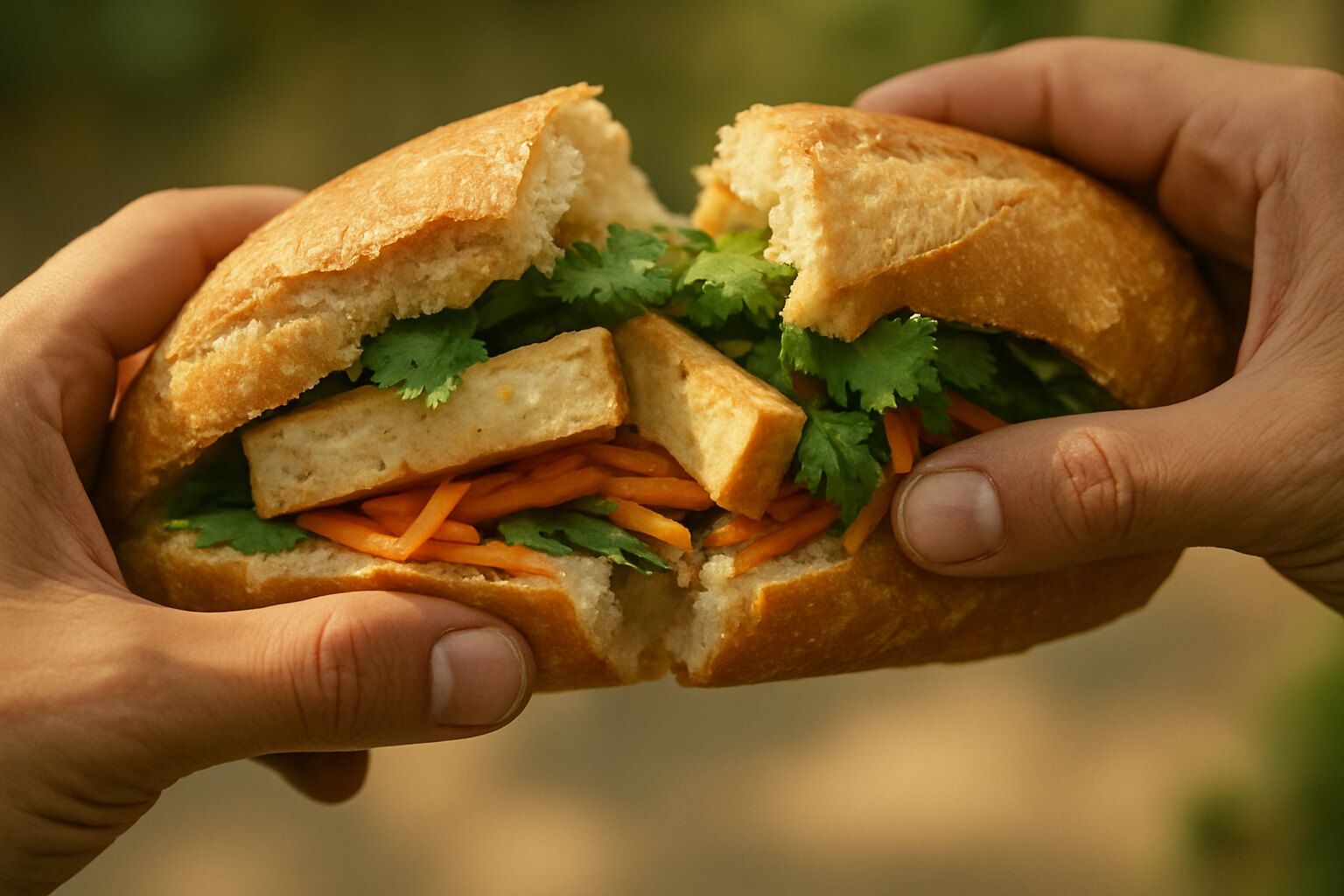
Is a vegan banh mi actually vegan? Six places where it slips
There is a question customers are often too shy to ask out loud: is this loaf marked “vegan” actually vegan? It is a reasonable question, and a decent seller will not take offence. Vietnamese banh mi is assembled from a dozen or so components, most of them bought in rather than made on site — so one animal-derived item among them makes the whole loaf not vegan, even where nobody set out to mislead.
This is where it slips most often, and the three short questions that settle it.
Why this happens without anyone intending it
An ordinary banh mi stall adds a vegan option by taking the meat out and putting tofu in. The meat part is visible. Everything else — the pâté, the sauce, the pickles, the butter brushed inside the crust — comes from the same jars, the same tubs, the same supplier as before. The seller believes the job is done: there is no meat in the loaf. Someone who eats vegan full-time is counting differently.
That is the gap between taking the meat out and being vegan. They are not the same thing, and most of the misunderstanding sits in exactly that distance.
The six places it slips
1. Pâté
Pâté is the easiest place for it to slip, because it is spread thinly along the base of the loaf, greyish brown, and indistinguishable by eye. Traditional pâté is pork liver, pork fat and milk. Vegan pâté is beans, mushrooms, taro or cashews blended smooth. Side by side in a chiller, the two look almost identical.
What actually separates them: vegan pâté is usually paler, leaning yellow or light grey, and carries no liver smell — that smell is distinctive enough that one encounter is enough to recognise it. Pork pâté left in a chiller sets a cloudy white layer of fat on its surface; a bean-and-mushroom version does not.
2. Mayonnaise
This is the quietest slip, because nobody thinks of it. Commercial mayonnaise is made from egg yolk and oil. It arrives in the loaf as a stripe of pale, rich, slightly sour sauce. Plenty of stalls use the same bottle on a vegan loaf, on the grounds that it is not meat.
The vegan substitute is usually soy or vegetable oil whipped with lemon juice. Lighter, less unctuous, and with no egg finish — that faint eggy note that settles at the back of the throat after swallowing.
3. The pickles
Pickled carrot and daikon is the thing everybody assumes is safe. But many stalls' pickle recipe carries a little fish sauce to round the flavour, not only vinegar and sugar. The quantity is small, added for the finish, and it is never written on a board.
This is the detail people keeping vegan days tend to skip over and full-time vegans watch closely. If you are in the second group, the pickles are worth asking about more than the pâté is.
4. Butter brushed on the crust
Many stalls brush a thin film of butter inside the loaf before the filling goes in, so the crust does not soften. That butter may be dairy butter or plant-based margarine. For someone who eats vegetarian with eggs and dairy it makes no difference. For a full vegan it is a genuine slip.
5. Vegan cold cut and vegan sausage
The name says vegan, but plenty of industrially made vegan cold cut uses egg white as the binder that keeps the slice springy rather than crumbly. Versions made without egg bind with starch or wheat gluten instead, and the texture differs — softer to bite, with less bounce.
This is the group where you have to read the ingredients on the packet; the eye will not tell you.
6. The crust itself
A basic loaf is flour, water, salt and yeast — entirely vegan. But some bakeries add milk powder for a softer crumb, or animal fat to keep the crust crisp for longer. Not every bakery does, and none of it is written on the loaf.
In practice this is the hardest one to check, because the person selling banh mi is usually not the person who baked it. Anyone eating strictly should ask their regular shop where the bread comes from.
Three short questions at an unfamiliar stall
No interrogation required. These three cover most of the risk, and take ten seconds:
- “Is the pâté vegan or the ordinary one?” — this filters the biggest slip.
- “Does the white sauce have egg in it?” — say the word “egg” rather than asking whether it is vegan, because sellers often hear “vegan” as “no meat”.
- “Is there fish sauce in the pickles?” — the least-asked question, and the one that most often produces a surprise.
If the seller hesitates on any of them, that is the thing to leave out of your loaf. “Without that, please” is enough; no explanation needed.
Three levels, three different questions
The same word covers three different practices, so the advice has to differ:
- Vegan days — a few days a month, usually the first and the fifteenth of the lunar month. This group mainly needs to know there is no meat or fish in the loaf. Question one is enough.
- Full-time vegetarian — year-round, with most people still accepting eggs and dairy. This group should add question three about the pickles.
- Fully vegan — nothing animal-derived at all. This group needs all three, plus the question about butter on the crust.
How it works at Banh Mi XANH
The shops were built fully vegan from the start rather than being an ordinary banh mi stall with a vegan line added, so there is no old sauce bottle or shared pickle tub. The fillings are tofu and soy-based vegan cold cut, with fresh herbs, cucumber and pickles. No meat, no seafood, no fish sauce in any item.
The menu is Thập Cẩm at 59,000d, Chả Lát Chay at 53,000d, Đậu Hũ Cay at 56,000d, Bơ Đường at 28,000d and the big Thượng Hạng Premium at 75,000d. On the six points above: the shops are fully vegan in the sense of using nothing connected to animals — so the butter is plant-based rather than dairy, the sauce has no egg yolk, the cold cut uses no egg white as a binder, and the pickles are vinegar and sugar with no fish sauce. Anyone keeping vegan days, eating vegetarian full-time or eating fully vegan can have all five loaves without asking item by item.
If anything still leaves you unsure, ask the staff directly — the five shops are open 24 hours, so there is always somebody at the counter who can answer, with no waiting for office hours.
The five shops are at 38 Lê Thị Riêng, 15B Nguyễn Thị Minh Khai, 2B Trần Hưng Đạo and 148B Đề Thám in District 1, and 210 Bùi Văn Ba in District 7. For delivery call 0923.183.183; orders from 500,000d within 5km are delivered free.
Quick questions
Can I tell vegan pâté from the ordinary kind by looking?
Vegan pâté is usually paler, leaning yellow or light grey, and has no liver smell. Pork pâté kept chilled tends to set a cloudy white fat layer on top; a bean-and-mushroom version does not. But looking is only a guess — one question is more reliable.
Does banh mi mayonnaise always contain egg?
Commercial mayonnaise does, because egg yolk is what holds the sauce together. The vegan version uses soy or vegetable oil whipped with lemon juice — lighter, and with no eggy finish.
If the pickles contain fish sauce, does that matter on a vegan day?
That is yours to set. Most people keeping the first and fifteenth do not count the small amount of fish sauce seasoning a pickle; full-time vegetarians and vegans do. There is no common standard — only your own.
Does vegan cold cut contain egg, and can I see it?
You cannot see it. Plenty of industrially made vegan cold cut uses egg white as a binder. Versions made without it bind with starch or wheat gluten and bite softer with less bounce. Reading the ingredients on the packet is the only reliable way.
Can the crust really not be vegan?
It can happen. A basic crust is flour, water, salt and yeast and so entirely vegan, but some bakeries add milk powder for a softer crumb or animal fat to keep the crust crisp. Anyone eating strictly should ask their regular shop where the bread comes from.
Does Banh Mi XANH use dairy butter or egg anywhere?
No. The shops are fully vegan in the sense of using nothing connected to animals, so the butter is plant-based, the sauce has no egg, the cold cut uses no egg white, and the pickles are vinegar and sugar only. All five loaves suit a fully vegan diet.
Will the seller mind being asked all this?
A decent one will not, because the question helps them sell you the right thing. Keep it to three questions in ten seconds and ask plainly rather than as an interrogation — it is an ordinary thing to do at a counter.

New to Saigon and eating vegan: three areas worth knowing
Saigon has plenty of vegetarian places, but they aren't spread evenly. Knowing three areas and two time patterns makes the first month far easier.
Ordering through a delivery app or calling the shop: what actually differs
Two ways to order the same sandwich, differing in price, in speed, and most importantly in whether you can explain what vegan means to you.
Eating vegan at 2am around Bui Vien and De Tham: how to get there
The backpacker quarter stays awake until dawn, but most of what's open doesn't serve vegan food. Here's how to get from the middle of it to something
Banh mi, rice or noodle soup: choosing by the clock and by appetite
Three vegan meals that solve three different problems. Choosing by the time of day and by what you're about to do works better than choosing by cravin
 ›
×

Vegan banh mi and plant-based coffee in Ho Chi Minh City. Five shops open 24/7 including Sundays and holidays. Free delivery within 5km on orders from 500,000d.
Brand strategy by Ten Mien Dang Cap
© 2026 Bánh Mì XANH. All rights reserved.