
How many uses before a cotton tote pays off against a plastic bag
You switch to a cotton tote and feel better about it. But there is a question few people ask: how many times does that tote have to be used before it is genuinely better than the plastic bag it replaced?
The answer surprises people — and the honest way of answering is more useful than the number.
Why a tote starts in debt
A plastic bag is very thin, very light, quick to make and uses little material. A cotton tote is the opposite: cotton is a crop that needs a great deal of water, land and fertiliser, and then has to be spun, woven, dyed and sewn.
Which means that the moment you carry a tote home, it already owes far more environmental impact than the plastic bag did. It repays that debt only by being used many times.
What the number is — and why nobody can give you one
This is where honesty matters. Life-cycle studies produce widely differing figures, from a few dozen uses to several thousand. That spread is not because some studies are wrong, but because:
- Which impact is measured. Measure greenhouse gases and you get one figure; measure water use and you get a very different, usually much larger one, because growing cotton is water-hungry.
- Which plastic bag is the comparison. A flimsy one is not a thick one, and whether it gets reused as a bin liner changes the result considerably.
- How waste is handled where you are. Somewhere with good collection is not the same as somewhere bags end up in rivers and the sea.
- Whether the tote is conventional or organic cotton, new or recycled.
So anybody handing you one confident number is usually leaving most of the story out. What can be said with confidence is: the number is large — dozens to hundreds of uses — not three or four.
But that uncertainty points somewhere very clear
Without the exact number, three things still follow, and they are the usable part:
1. The greenest bag is the one you already own
Buying another tote creates another debt. Every household already has totes from trade fairs, from gifts, from shopping. Use those up first.
2. Number of uses matters more than material
A thick plastic bag reused fifty times may well beat a cotton tote used three times and left in a cupboard. The right question is not “what is the bag made of” but “will I actually use it”.
3. So the thing that matters most is where you keep it
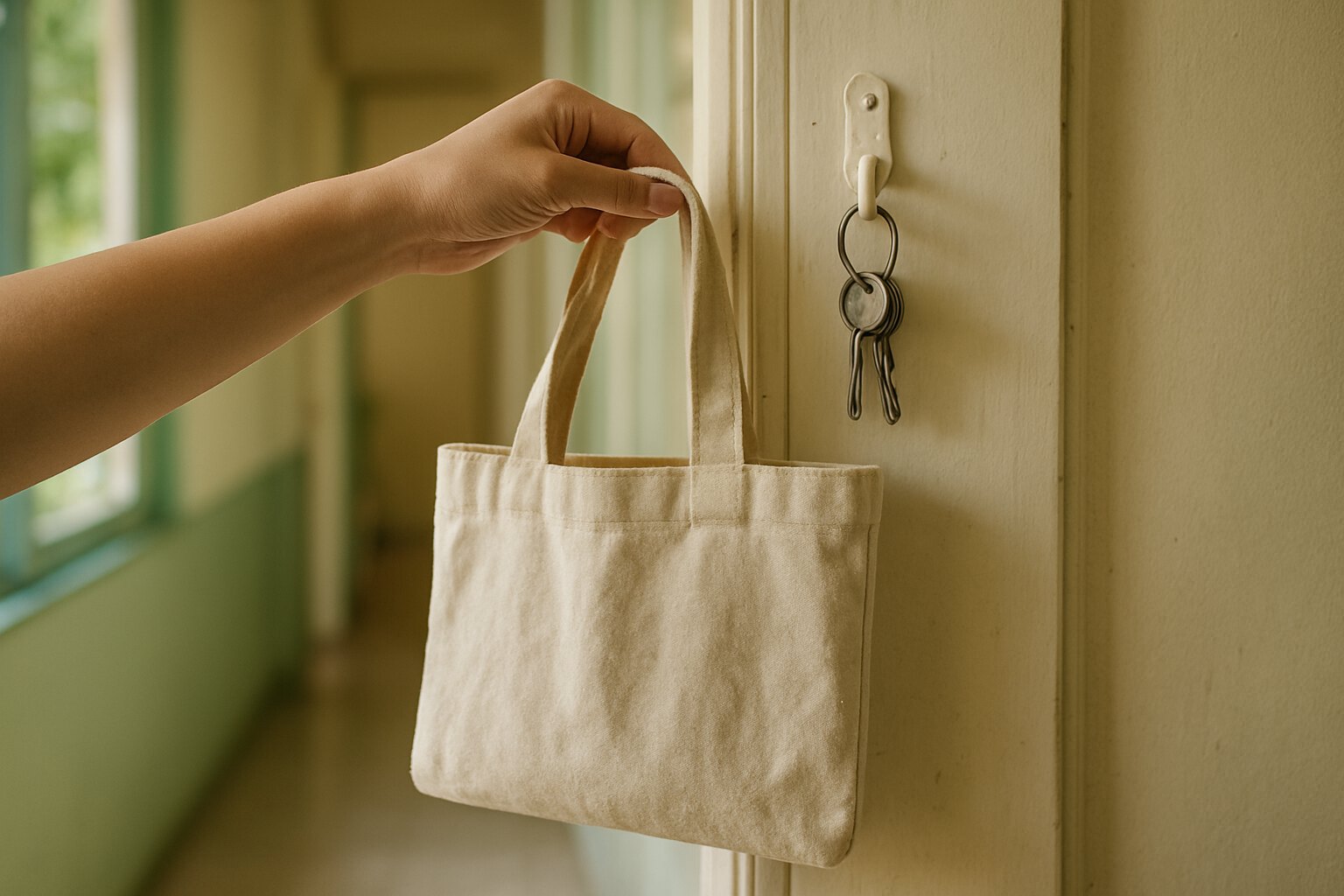
This is the practical part. A tote in a kitchen cupboard is a tote that never gets used. Keep it where you look before leaving — by the keys, by the shoes, under the seat of your bike — and the number of uses multiplies, and that debt is repaid far sooner.
Choosing one that lasts
- Folding small matters more than looking good. A tote that folds into your palm lives in your bag; a big stiff one lives at home.
- Light mesh bags for loose produce, replacing the small plastic bags at the counter — that is where the bags actually accumulate, not at the till.
- Straps long enough to go over a shoulder. A bag that must be carried by hand gets abandoned when it is heavy.
- Wash when needed, and wash cold. Produce bags should be washed periodically. Cold water and line drying keeps the added impact down.
When it tears
Do not bin it immediately. A tote with a broken strap still works as a storage bag, a cloth, a rag. Extending its life one more stage is how the rest of the debt gets paid.
At a banh mi counter
A loaf comes wrapped in paper, so in most cases no bag is needed at all — carry it in your hand. For several loaves, the tote you already brought is enough.
Banh Mi XANH packs the way you ask; just say so when ordering. The five shops are open 24 hours: 38 Lê Thị Riêng, 15B Nguyễn Thị Minh Khai, 2B Trần Hưng Đạo and 148B Đề Thám in District 1, and 210 Bùi Văn Ba in District 7. Call 0923.183.183; orders from 500,000d within 5km are delivered free.
Quick questions
How many uses does a cotton tote need to break even?
There is no single number — studies give anything from a few dozen to several thousand, depending on which impact is measured and which plastic bag is the comparison. What is certain is that it is large: dozens to hundreds, not three or four.
Why do the studies disagree so much?
Measuring greenhouse gases gives one figure; measuring water gives a very different one, because cotton is water-hungry. It also depends on which plastic bag is compared and whether it is reused as a bin liner.
So is using a tote worthwhile?
Yes, but only if used enough. The greenest bag is the one you already own — buying another creates another debt.
How do I make sure I actually use it?
Keep it where you look before leaving the house — by the keys, by the shoes, under the bike seat. A tote in a kitchen cupboard never gets used.
Can a reused plastic bag beat a tote?
It can. A thick plastic bag reused fifty times may beat a cotton tote used three times and abandoned. The right question is the number of uses, not the material.
What do I do when a tote tears?
Not the bin. A broken strap still leaves a storage bag, a cloth, a rag. One more stage of life is how the rest of the debt gets paid.

Commuting in Saigon without a motorbike: try it for a week
Giving up the motorbike for a week sounds impractical in Saigon. But trying it shows which journeys can be replaced and which can't — and the cost fig

How much water a vegan meal uses, and where to cut it
Water in a kitchen isn't only what runs from the tap. Most of it is invisible — and so is the place where the most can be saved.
Arranging the fridge so vegetables last twice as long
Greens wilting after three days usually isn't the produce's fault — it's where they were put. A fridge has several temperature zones, and each vegetab
A reusable bottle versus plastic bottles: counting money and counting waste
Everyone knows a reusable bottle is better environmentally. Run the numbers, though, and the most convincing argument is money — and it pays back soon
 ›
×

Vegan banh mi and plant-based coffee in Ho Chi Minh City. Five shops open 24/7 including Sundays and holidays. Free delivery within 5km on orders from 500,000d.
Brand strategy by Ten Mien Dang Cap
© 2026 Bánh Mì XANH. All rights reserved.