
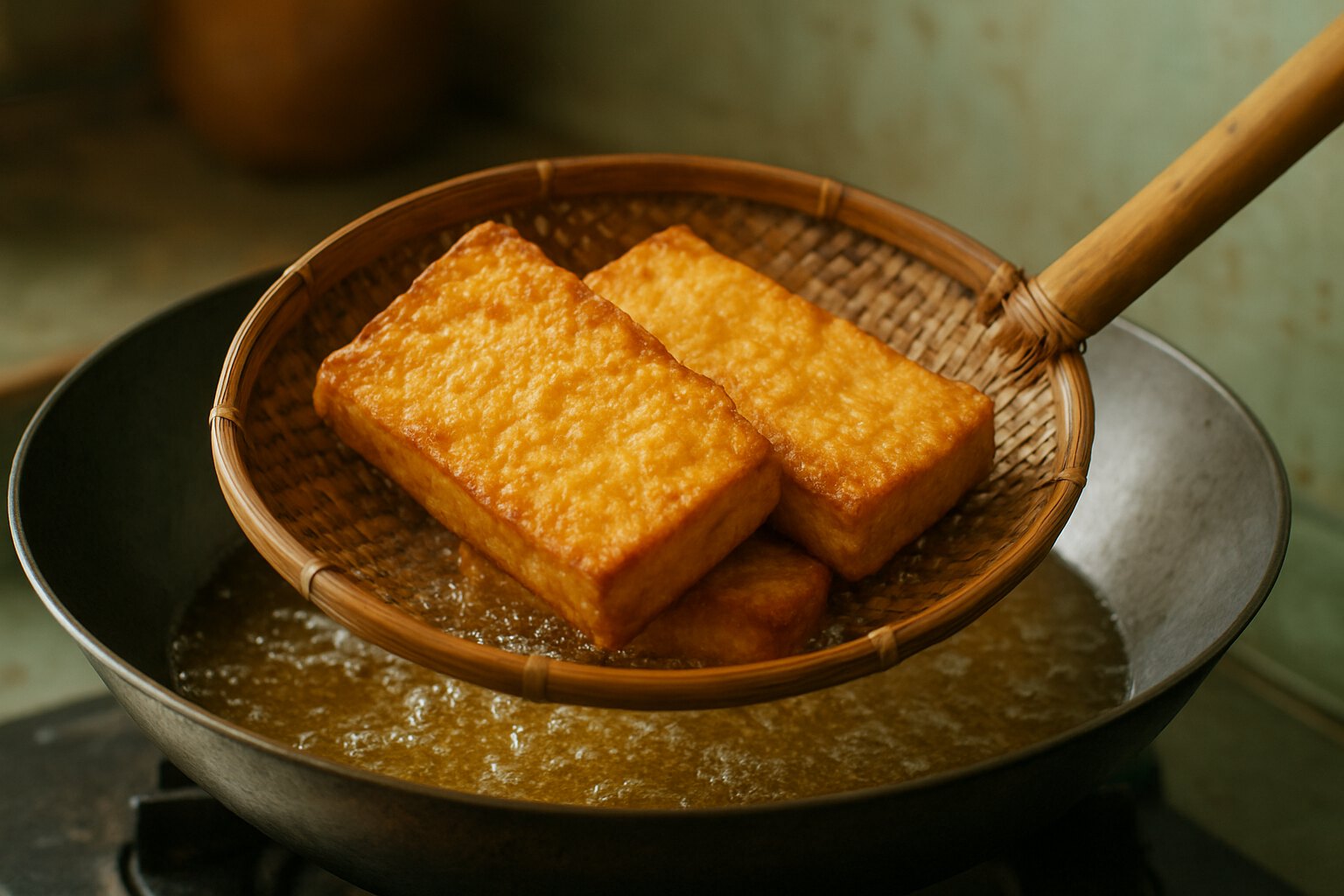
How long fried tofu stays crisp, and why it is fried in small batches
A piece of tofu straight out of the oil, the crust audibly breaking under the bite, soft and hot inside — that is it at its best. Twenty minutes later the same piece has a leathery crust and no sound at all. Nobody did anything wrong; it is simply what happens, and understanding it explains why a shop does not fry once for the whole day.
The crust softens from the INSIDE
Dropped into hot oil, the water in the outer layer evaporates fast, leaving a dry, hard crust. The inside does the opposite: still full of water, heated but not dried.
Out of the oil, the piece begins to cool. Water in the core migrates outward — water always moves from where there is more to where there is less. The dry crust meets that water and takes it up, and softens.
Which means fried tofu softens itself, with nobody's help. The practical timings:
- 0 to 10 minutes — clearly crisp, audible under the bite.
- 10 to 20 minutes — still crisp but fading, the sound getting smaller.
- 20 to 40 minutes — leathery; no longer honestly crisp.
- After an hour — fully soft. Still good, but a different dish.
Cover it or stack the pieces and every one of those timings halves, because the steam has nowhere to go.
Why shops fry in small batches
Fry a day's worth in the morning and by midday customers get leathery tofu. Frying in small batches, estimated against the traffic of each hour, means the tofu goes into the loaf inside that first twenty minutes.
It is far more work — the kitchen has to watch it, has to guess wrong sometimes, and customers occasionally wait a few minutes more. What it buys is the one thing worth buying: tofu that is still crisp when it reaches you.
It is also why ordering Đậu Hũ Cay at 56,000d in the busy hours is often better than in a quiet one: when the shop is full, batches come out continuously and the tofu is almost always fresh.
Frying it crisper at home
You cannot repeal the water-moves-outward rule, but you can slow it down:
Press out water before frying
The most important step and the most often skipped. Put the tofu between two layers of kitchen paper with a weight on top for about twenty minutes. Less water in the core means less water to push into the crust, and the crust lasts markedly longer.
The oil has to be hot enough
Around 175–180°C. Without a thermometer, drop in a small piece: if it floats immediately and bubbles evenly, you are there; if it sinks and rises slowly, the oil is too cool. Cool oil means the tofu absorbs oil instead of forming a crust — producing something limp and greasy.
Do not crowd the pan
Tipping a whole basket in drops the oil temperature at once, which returns you to the problem above. Fry in two or three goes, letting the oil come back up between them.
Drain on a rack, not on paper
On kitchen paper the underside sits in its own steam and softens first. A rack lets air move all the way round, so both faces stay crisp.
A thin coating if you want it to last
Roll the pieces in a thin layer of cornflour before frying. Cornflour makes a drier crust and blocks the water from within better than a bare surface does. The trade-off is that it masks some of the tofu flavour, so it is a matter of taste.
Can fried tofu be re-crisped?
Yes, and how you do it decides the result:
- Air fryer, 180°C for 4–5 minutes — the best; it very nearly restores it.
- Dry pan over medium heat, turned — works, but the thin edges catch easily.
- Oven, 200°C for 6–8 minutes — even, and right for a lot of pieces.
- Microwave — don't. It does exactly what we are trying to avoid: drives steam into the crust.
Fried tofu keeps two days in the fridge. Beyond that it is still edible but the texture has changed entirely.
At the shops
Fried tofu is the main filling of Đậu Hũ Cay at 56,000d and appears in Thập Cẩm at 59,000d and Thượng Hạng Premium at 75,000d. Eating in is always a notch better than taking away, purely because of time.
If you are taking it away and want the crust: ask for the tofu separately and add it on arrival. Sitting in a loaf with salad and pickles is the dampest environment available.
The five shops are open 24 hours: 38 Lê Thị Riêng, 15B Nguyễn Thị Minh Khai, 2B Trần Hưng Đạo and 148B Đề Thám in District 1, and 210 Bùi Văn Ba in District 7. For delivery call 0923.183.183; orders from 500,000d within 5km are delivered free.
Quick questions
How long does fried tofu stay crisp?
Clearly so for the first ten minutes, still crisp to about twenty, and leathery after forty. Covering or stacking the pieces halves all of those.
Why does the crust soften when nobody has touched it?
Water in the core migrates outward as the piece cools, and the dry crust takes it up. The tofu softens itself — it is not a sign of under-frying.
Why does oil that is not hot enough make tofu greasy?
Cool oil lets the tofu absorb oil instead of forming a crust straight away. Test by dropping in a small piece: it should float at once and bubble evenly.
Should I press the tofu before frying?
Yes, and it makes the biggest difference. Twenty minutes between kitchen paper under a weight. Less water in the core means less water pushed into the crust, and it stays crisp much longer.
What is the best way to re-crisp it?
An air fryer at 180°C for 4–5 minutes. Avoid the microwave, which drives steam into the crust — precisely what you are trying to prevent.
How do I keep the tofu crisp on a takeaway?
Ask for it separately and add it when you get there. In the loaf with salad and pickles is the dampest place it could be, and the crust goes fastest.

What to eat alongside a banh mi to make it a complete meal
A sandwich has starch and protein but is short on a few things. Adding one or two items is the difference between a stopgap and a proper meal.
Salt, pepper and sugar in a vegan sandwich: why vegan food tastes flat
Vegan food gets called bland, but not because it's under-salted. The cause is something plant ingredients lack — and adding salt is the wrong fix.
Ordering Spicy Tofu when you can't take heat: four adjustments
The heat in a sandwich doesn't come from one place, so it can be dialled down by degrees rather than being all-or-nothing.
How much is in one banh mi, and how long does it hold you
A simple question with a three-part answer — and the part that matters most isn't the weight of the sandwich.
 ›
×

Vegan banh mi and plant-based coffee in Ho Chi Minh City. Five shops open 24/7 including Sundays and holidays. Free delivery within 5km on orders from 500,000d.
Brand strategy by Ten Mien Dang Cap
© 2026 Bánh Mì XANH. All rights reserved.