
Spent coffee grounds are worth keeping: five things to do with them
After the coffee is made, what is left in the filter goes straight into the bin in almost every household. But spent coffee grounds are unusual among kitchen leftovers: clean, not smelly, almost dry, and genuinely useful — quite unlike fruit peel or plate scrapings.
Five things you can do with them today, with nothing to buy.
1. Deodorising a fridge or a cupboard
The most effective and the easiest. Coffee grounds are porous, so they absorb odours well, and they carry a pleasant smell of their own that covers unpleasant ones.
Method: dry them thoroughly, put them in an open bowl or tub, and leave it in a corner of the fridge. Replace every two weeks.
The usual mistake: putting damp grounds into the fridge. Damp grounds in an enclosed space grow mould fast — a white bloom within days. They have to be properly dry first.
The same approach works for shoe cupboards, kitchen drawers and dry-goods containers.
2. Scouring pans and removing smells from hands
Coffee grounds are moderately abrasive — enough to shift burnt residue from a pan base without scratching the way steel wool does. Good for cast iron, stainless steel and baking trays.
Do not use them on white ceramic, pale sinks or light stone — coffee stains, and brown marks in the seams are very hard to remove.
One small use that is unexpectedly good: after chopping onion, garlic or ginger, rub a little coffee grounds on your hands before washing. It removes the smell better than ordinary soap.
3. Feeding plants — but correctly
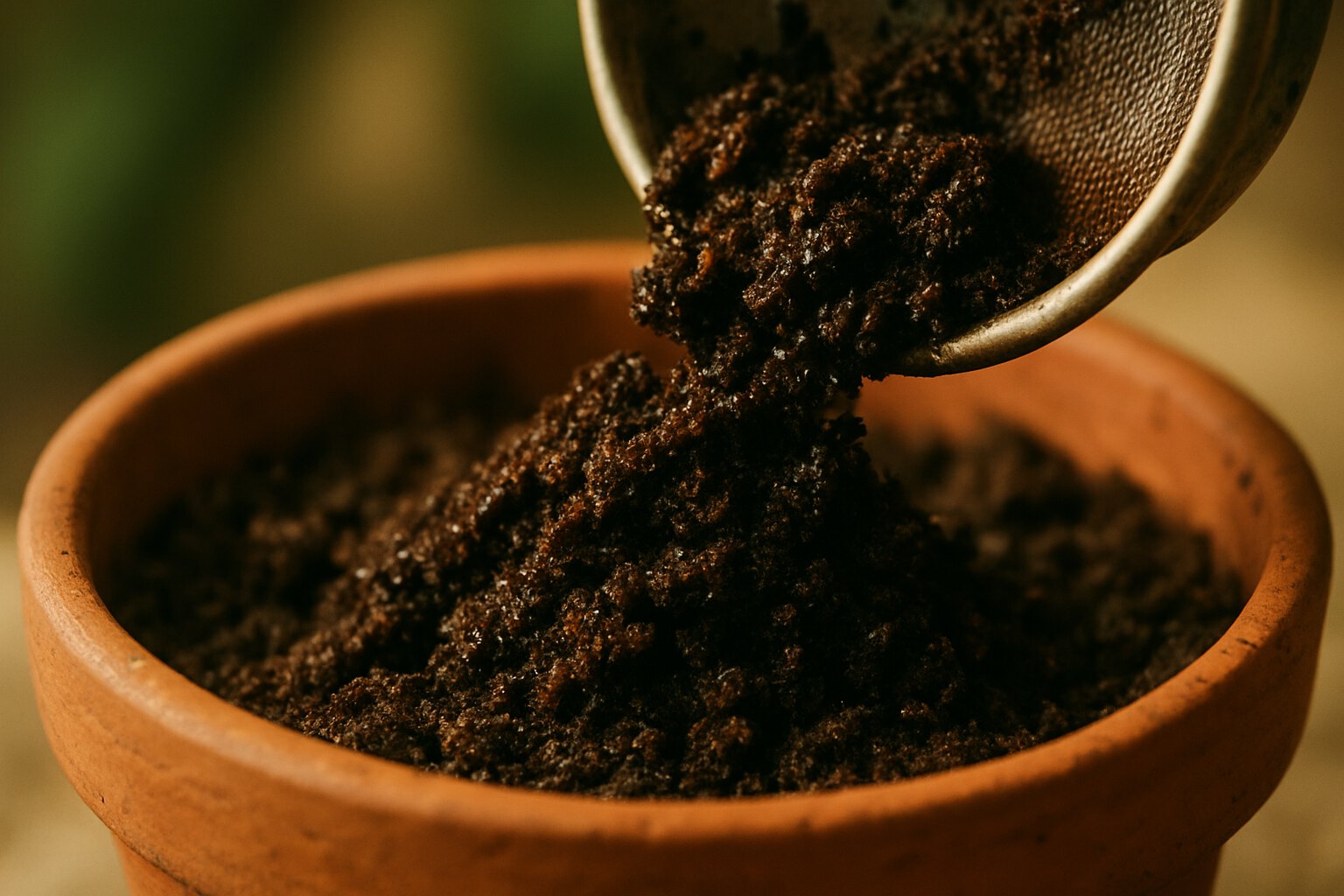
This is the most misunderstood. Coffee grounds contain nitrogen, so they are good material. But scattering a thick layer on the soil surface harms the plant: damp grounds compact into a mat that blocks water and air, and the roots suffocate.
The right way:
- Mix into the soil rather than scattering on top. A small proportion — one part grounds to ten parts soil is already plenty.
- Or scatter very thinly and rake it into the surface layer.
- Acid-loving plants such as strawberries, blueberries and hydrangeas suit it best.
One myth to drop: “coffee grounds acidify the soil, so avoid them”. In fact, in spent grounds most of the acid has already gone into the cup, and what remains is fairly mild. Their real problem is compacting into a mat, not acidity.
4. Composting
If you have a compost bin, coffee grounds are excellent material. They belong to the “green” group — nitrogen-rich — despite being brown to look at.
The principle: mix greens (coffee grounds, vegetable trimmings, tea leaves) with “browns”, the carbon-rich group (scrap paper, dry leaves, torn cardboard). The ratio usually cited is about one part green to two or three parts brown.
Too many grounds without enough browns and the bin goes sodden, smelly and slow. The paper filter can go in with them — that is a brown.
5. Deterring ants and slugs
Scatter a line of dry grounds around a pot or along a route ants use. They avoid the smell and the loose surface.
To be fair about it: this works moderately and does not last. One shower of rain washes it away, and a determined column of ants goes straight through. Treat it as a mild measure, not as an insecticide.
Storage: the thing that decides all of the above
Nearly every failure with coffee grounds comes down to one thing: storing them damp.
- Damp grounds in a sealed tub go mouldy in two or three days.
- To keep them, spread them thinly on a tray, dry them in the sun or somewhere airy until properly dry, then store in a sealed jar.
- Properly dry, they keep for months.
If you make little coffee, collect for a few days and dry a batch at a time.
Asking a café
If you do not make coffee at home but want the grounds, asking a café is the simplest route — every one has a surplus and most are happy to give them. Bring a tub or bag, and dry them as soon as you get home, because café grounds are always very wet.
At Banh Mi XANH the drinks include Black Coffee at 35,000d and Nut Milk Coffee at 45,000d. The five shops are open 24 hours: 38 Lê Thị Riêng, 15B Nguyễn Thị Minh Khai, 2B Trần Hưng Đạo and 148B Đề Thám in District 1, and 210 Bùi Văn Ba in District 7. For delivery call 0923.183.183; orders from 500,000d within 5km are delivered free.
Quick questions
Can I scatter coffee grounds straight onto a pot plant?
Better not. Damp grounds compact into a mat that blocks water and air, and the roots suffocate. Mix them into the soil in a small proportion, or scatter very thinly and rake them in.
Do coffee grounds acidify soil?
Far less than the myth suggests. In spent grounds most of the acid has already gone into the cup. Their real problem is compacting into a mat, not acidity.
Why do coffee grounds go mouldy in the fridge?
Because they went in damp. Damp grounds in an enclosed space mould within two or three days. Dry them thoroughly before using them to deodorise.
Will scouring with coffee grounds damage anything?
They suit cast iron, stainless steel and baking trays. Avoid white ceramic, pale sinks and light stone — coffee stains, and brown marks in the seams are hard to shift.
Do coffee grounds really deter ants?
Moderately, and not for long. One shower washes it away and a determined column goes straight through. A mild measure, not an insecticide.
How long do coffee grounds keep?
Dried thoroughly and sealed in a jar, for months. Stored damp, two or three days before mould — nearly every failure comes down to this.

Commuting in Saigon without a motorbike: try it for a week
Giving up the motorbike for a week sounds impractical in Saigon. But trying it shows which journeys can be replaced and which can't — and the cost fig

How much water a vegan meal uses, and where to cut it
Water in a kitchen isn't only what runs from the tap. Most of it is invisible — and so is the place where the most can be saved.
Arranging the fridge so vegetables last twice as long
Greens wilting after three days usually isn't the produce's fault — it's where they were put. A fridge has several temperature zones, and each vegetab
A reusable bottle versus plastic bottles: counting money and counting waste
Everyone knows a reusable bottle is better environmentally. Run the numbers, though, and the most convincing argument is money — and it pays back soon
 ›
×

Vegan banh mi and plant-based coffee in Ho Chi Minh City. Five shops open 24/7 including Sundays and holidays. Free delivery within 5km on orders from 500,000d.
Brand strategy by Ten Mien Dang Cap
© 2026 Bánh Mì XANH. All rights reserved.