
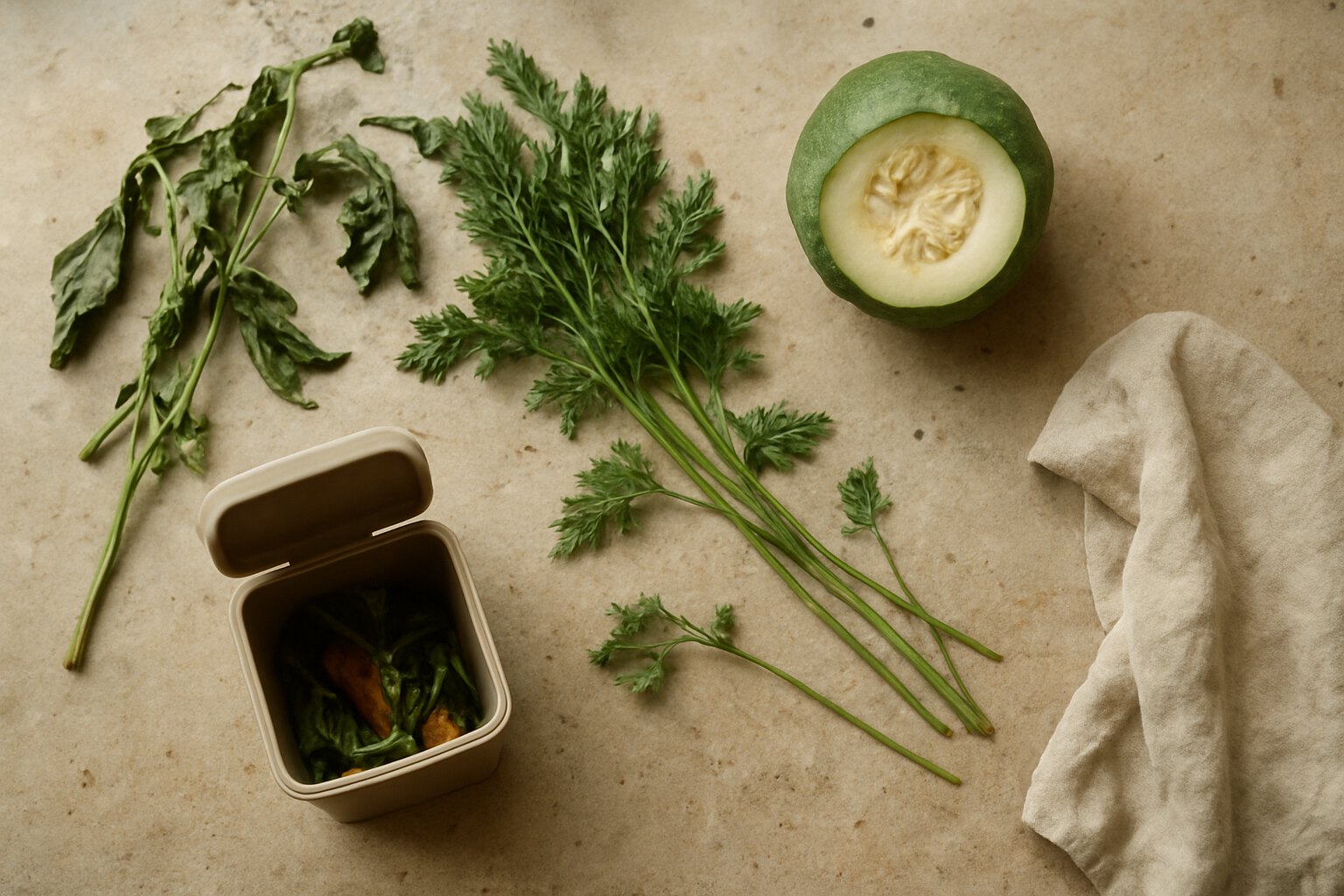
Five places food gets wasted in a kitchen without anyone noticing
Ask anybody and they will say their household does not waste food. Count it honestly for a week and the figure usually surprises people — and most of it was not spoiled. It was forgotten, trimmed away too generously, or binned because of a misread line on a packet.
1. The vegetable drawer — number one, uncontested
The vegetable drawer is where food goes in and nobody looks again. Vegetables bought on Sunday, a busy week, and by Friday they are limp.
Three things change this:
- Do not wash before storing. Water on the leaves is where rot starts. Wash when you are about to cook.
- Wrap in paper, not a sealed bag. Leafy greens wrapped in slightly damp kitchen paper inside an open bag keep twice as long.
- Put the older things at the front. It sounds too simple, but this addresses the root cause: vegetables spoil because nobody sees them.
And a practical rule: leafy greens in the first two or three days, roots and gourds later. Buy greens and squash the same day and cook the greens first; the squash will keep until next week.
2. Trimming away too much
A lot is cut off out of habit rather than because it is inedible:
- Water spinach stems, cabbage ribs — firmer than the leaves but sweeter. Cut short and cooked a little longer, they are good, sometimes better.
- Mushroom stems — most mushrooms are edible stem and all. Chewy ones can be chopped small into a stir-fry or a broth.
- Carrot and potato skins — scrub them and they need no peeling at all. Peeling removes the fibre that sits just under the skin.
- Celery and carrot leaves — aromatic; chop them in as a herb.
- The centre of young gourds — fine in soup, no need to scoop it out as with an older one.
One trick that catches all of it: keep a bag in the freezer for every offcut — stems, onion skins, mushroom stalks, coriander stalks. When the bag is full, make a vegetable stock. Rubbish turned into an ingredient with no extra effort.
3. Misreading the date on the packet
This is where the most is wasted, and the most unjustly, because the food is perfectly good.
Packaging carries two very different kinds of date:
- Use by — a safety date. Past it, do not eat.
- Best before — a quality date, not a safety one. Past it a biscuit may be less crisp and a spice less fragrant, but that does not mean spoiled.
Dry goods — rice, pasta, pulses, spices, sugar, salt — almost always carry the second kind. Use your nose and eyes with those rather than binning on a number. Fresh food, prepared food and anything with dairy should follow the date as printed.
4. Cooking too much and nobody touching it
A big pot of soup made to be safe, eaten once, put in the fridge, thrown out three days later. The problem is not the quantity — it is that leftovers are not seen.
- Store in clear containers at eye level in the fridge. An opaque box on a low shelf is a forgotten box.
- Give one meal a week to leftovers — many households use Friday evening. Knowing there is somewhere for it to go removes the fear of cooking extra.
- Portion before storing. One large container has to be reheated whole; reheated and not finished, it goes back — and every round costs it something.
5. Dry goods forgotten at the back
A bag of beans bought for a dessert and forgotten. A bottle of seasoning bought for one recipe and never used again. This group does not spoil fast, so nobody notices, and it sits there for years.
The simplest fix: clear the dry cupboard every three months, bring everything from the back to the front, and cook around those things that week. It tidies the cupboard and saves a shop.
Eating out
Waste when eating out usually comes from over-ordering. Ordering enough and adding more is easier than ordering too much and leaving it. A large loaf such as Thượng Hạng Premium at 75,000d is better split between two than ordered by one person who cannot finish it.
Whatever is not eaten can be wrapped to take home — banh mi keeps for a few hours if the salad is packed separately. Banh Mi XANH is open 24 hours: 38 Lê Thị Riêng, 15B Nguyễn Thị Minh Khai, 2B Trần Hưng Đạo and 148B Đề Thám in District 1, and 210 Bùi Văn Ba in District 7. Call 0923.183.183; orders from 500,000d within 5km are delivered free.
Quick questions
Where is the most food wasted in a kitchen?
The vegetable drawer, uncontested. Things go in and nobody looks again until they are limp. The root fix is simple: put the older items at the front, where they are seen.
Should I bin something past its “best before” date?
Not necessarily. That is a quality date, not a safety one — past it something may be less crisp or less fragrant. “Use by” is the safety date. Dry goods almost always carry the first kind.
Should vegetables be washed before going in the fridge?
No. Water on the leaves is where rot starts. Wash when you cook, and wrap leafy greens in slightly damp kitchen paper inside an open bag.
Are vegetable stems and mushroom stalks edible?
Yes. Water spinach stems and cabbage ribs are firmer but sweeter, and only need longer cooking. Mushroom stalks can be chopped small into a stir-fry or a broth.
How do I stop leftovers being forgotten?
Clear containers at eye level, and one meal a week set aside for leftovers. An opaque box on a low shelf is a forgotten box.
How do I waste less when eating out?
Order enough and add more rather than over-ordering. Split a large loaf between two. What is not eaten can be wrapped to take home if the salad goes separately.

Commuting in Saigon without a motorbike: try it for a week
Giving up the motorbike for a week sounds impractical in Saigon. But trying it shows which journeys can be replaced and which can't — and the cost fig
How much water a vegan meal uses, and where to cut it
Water in a kitchen isn't only what runs from the tap. Most of it is invisible — and so is the place where the most can be saved.
Arranging the fridge so vegetables last twice as long
Greens wilting after three days usually isn't the produce's fault — it's where they were put. A fridge has several temperature zones, and each vegetab
A reusable bottle versus plastic bottles: counting money and counting waste
Everyone knows a reusable bottle is better environmentally. Run the numbers, though, and the most convincing argument is money — and it pays back soon
 ›
×

Vegan banh mi and plant-based coffee in Ho Chi Minh City. Five shops open 24/7 including Sundays and holidays. Free delivery within 5km on orders from 500,000d.
Brand strategy by Ten Mien Dang Cap
© 2026 Bánh Mì XANH. All rights reserved.