
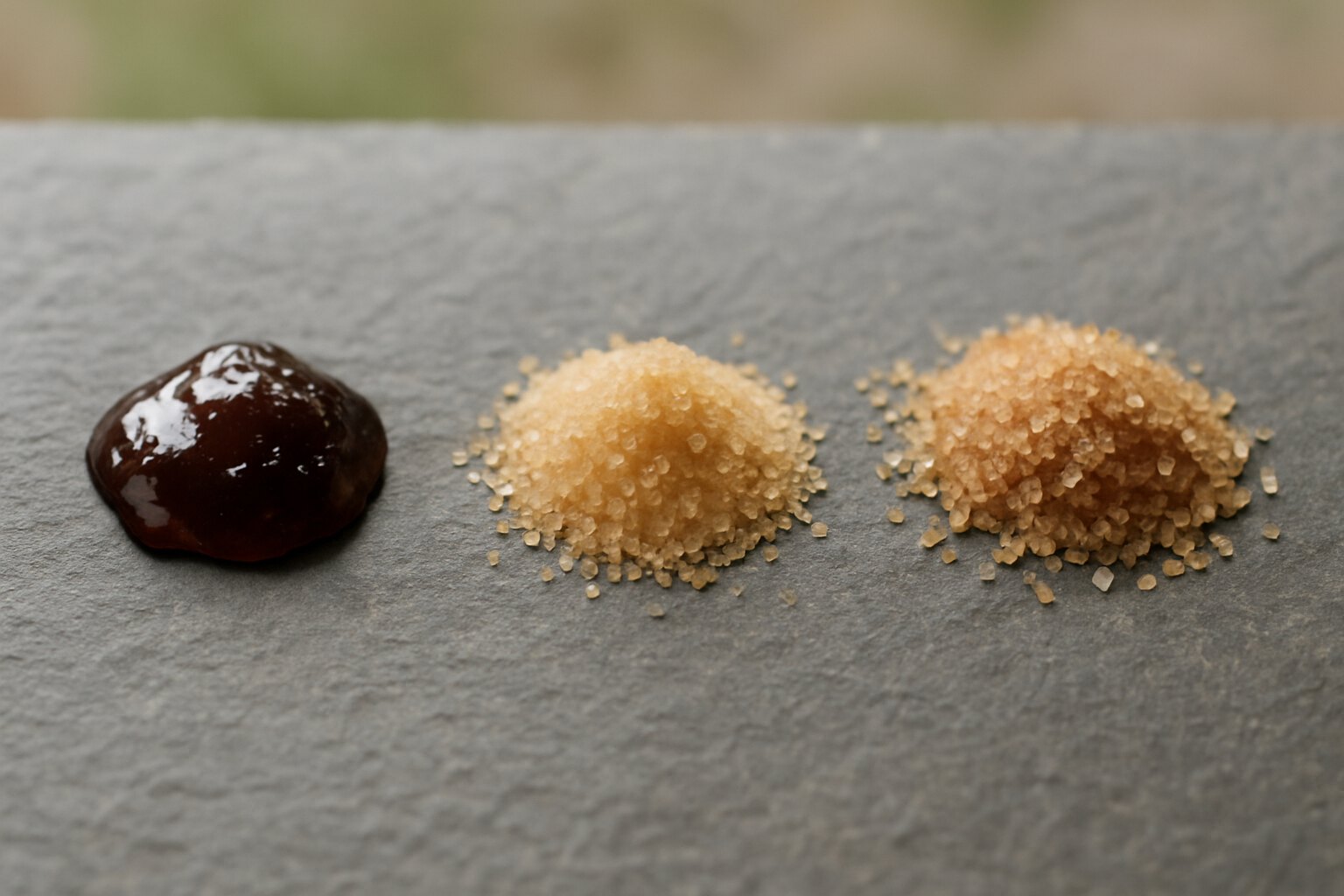
Brown sugar syrup, palm sugar and soft brown sugar: what actually differs
The supermarket shelf has several brown sugars sitting side by side, with similar names and quite different prices. Many people take whichever, on the grounds that brown sugar is brown sugar. In fact the three most common are made from three different things and taste quite different.
Brown sugar syrup (đường đen)
The most confusing, because the Vietnamese name describes the colour rather than the material.
Made from: cane juice reduced by long boiling until it darkens and thickens almost to a syrup. It does not go through the refining step that removes the molasses, so it keeps nearly all of it.
Taste: deeply sweet, with a faintly burnt caramel finish and a very slight sourness at the end. Strong and easy to recognise.
Used for: brown sugar bubble tea, sweet soups, braised savoury dishes. In a bubble tea it is that faintly burnt finish that creates the layer of flavour plain sugar cannot — it is the reason the drink exists.
Palm sugar
Made from: sap from the flower of the palmyra palm, not from cane. That is the root difference and the reason it tastes so distinct.
Taste: cleaner and less cloying than cane sugar, with a particular aroma somewhere between light caramel and butter. Less harsh, with a cleaner finish.
Used for: sweet soups, Mekong Delta braises, dipping sauces, coffee. This is what you reach for when you want sweetness that does not overwhelm the main flavour.
Genuine palm sugar is usually soft, slightly damp and easy to crumble, with an obvious aroma as soon as the packet opens. A version that is rock-hard and odourless is usually coloured cane sugar.
Soft brown sugar
Made from: the most contested of the three. Most mass-market brown sugar is refined white sugar with some molasses mixed back in — taken out and then returned. A minority is cane sugar that was never fully refined and retains its own molasses.
Taste: close to white sugar with a hint of molasses. Far milder than the syrup.
Used for: baking, or drinks where you want the colour without much change to the flavour.
Telling them apart quickly
| Syrup | Palm | Soft brown | |
| Source | Cane juice | Palm flower sap | Cane, mostly refined |
| Colour | Very dark brown | Pale golden brown | Light brown |
| Texture | Thick as syrup | Soft, crumbly | Loose damp crystals |
| Taste | Deep, faintly burnt | Clean, lightly buttery | Close to white sugar |
| Dominates a dish | Strongly | Little | Barely |
Can they be swapped?
For sweetness, near enough. For flavour, the dish changes:
- Swap the syrup for soft brown sugar in a brown sugar bubble tea and the burnt finish disappears — you get an ordinary sweet milk tea, no longer that drink.
- Swap palm sugar for the syrup in a sweet soup and the sugar overwhelms the beans and the coconut.
- Swap soft brown sugar for the syrup in baking and the result is much darker and heavier than intended.
The short rule: where the sugar is the foundation of the flavour, the syrup belongs; where the sugar should stay in the background, palm or soft brown suits better.
On nutrition
To be clear about it: all three are sugar. The less refined ones retain some minerals from the molasses, but the quantity is tiny relative to the sugar eaten, so none of them should be treated as a healthy sugar.
Anyone managing blood sugar should count all three the same. This is general information; anyone with a medical condition should ask their doctor.
At the shops
Brown Sugar Nut Milk Bubble Tea at 48,000d uses the genuine reduced cane syrup — that is what creates the faintly burnt finish and the dark streaks running down the inside of the glass. The standard Nut Milk Bubble Tea at 45,000d is more lightly sweet, for anyone who does not want it that deep.
Both are fully vegan: pearls from tapioca starch, milk from nuts, sugar from cane.
The five shops are open 24 hours: 38 Lê Thị Riêng, 15B Nguyễn Thị Minh Khai, 2B Trần Hưng Đạo and 148B Đề Thám in District 1, and 210 Bùi Văn Ba in District 7. Call 0923.183.183; orders from 500,000d within 5km are delivered free.
Quick questions
What is brown sugar syrup made from?
Cane juice, boiled down until dark and thick as syrup. It skips the refining step that removes molasses, so it keeps nearly all of it — which is where the faintly burnt finish comes from.
Is palm sugar a cane sugar?
No. It comes from palm flower sap rather than cane, which is why it tastes so different — cleaner, with an aroma between light caramel and butter.
How do I know palm sugar is genuine?
Genuine palm sugar is soft, slightly damp, easy to crumble, and has a clear aroma as soon as the packet opens. Rock-hard and odourless usually means coloured cane sugar.
Is soft brown sugar very different from white?
Not very. Most mass-market brown sugar is refined white sugar with molasses mixed back in, so it tastes close to white with a hint of molasses.
Can I use soft brown sugar in a brown sugar bubble tea?
For sweetness yes, but the burnt finish disappears — it becomes an ordinary sweet milk tea rather than that drink.
Is one of them healthier?
They are all sugar. The less refined ones retain some minerals, but the amount is tiny next to the sugar itself. Anyone managing blood sugar should count all three the same.

Hot or iced: which drinks suit which, and why
Not every drink works both ways. Temperature changes flavour, and some drinks lose their best quality entirely once ice goes in.
Caffeine in milk tea versus coffee: a sense of the numbers
Milk tea gets treated as a light drink, fine in the evening. But tea contains caffeine too, and some cups carry more than a small coffee.
Cubed, crushed or block ice: what it does to a drink
Same drink, different ice, and both the dilution rate and the drinking experience change. An overlooked variable with a visible effect.
Jasmine in lemon tea: real flowers or added flavouring, and how to tell
Real jasmine tea is scented with fresh flowers over repeated rounds — laborious work. Flavoured tea is tea sprayed with scent. Three signs separate th
 ›
×

Vegan banh mi and plant-based coffee in Ho Chi Minh City. Five shops open 24/7 including Sundays and holidays. Free delivery within 5km on orders from 500,000d.
Brand strategy by Ten Mien Dang Cap
© 2026 Bánh Mì XANH. All rights reserved.